
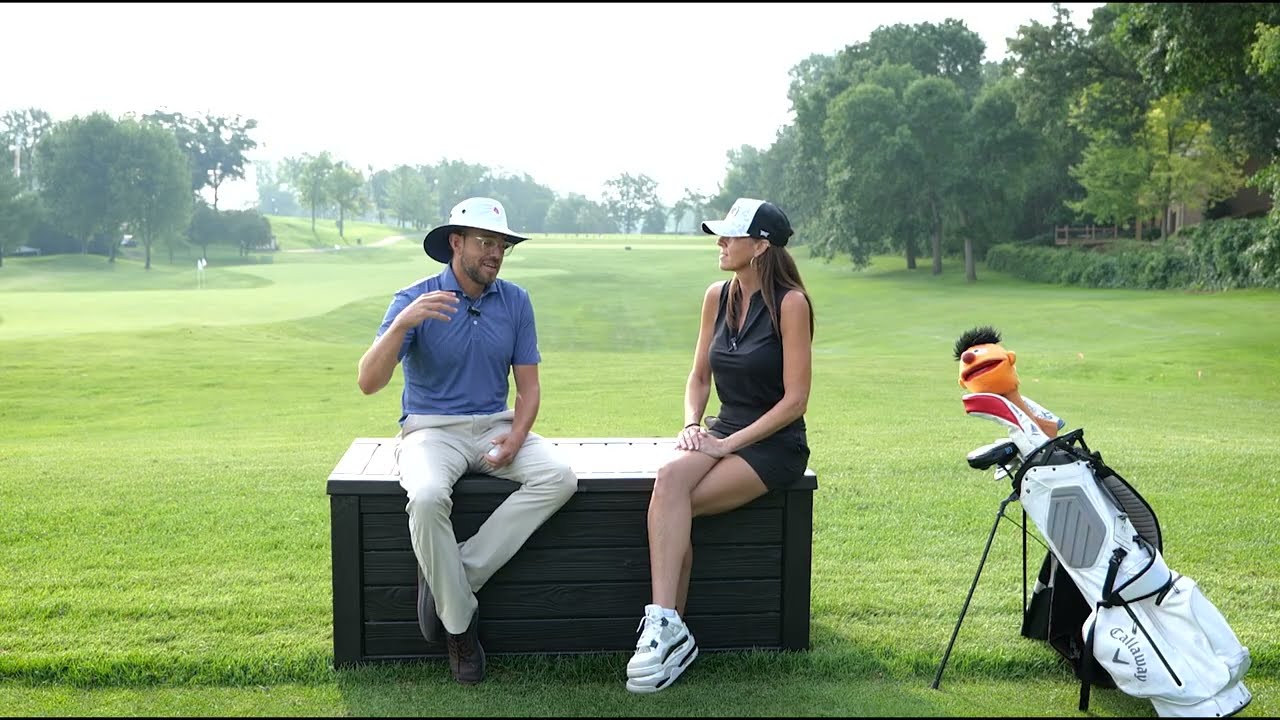
Why Most Golfers Never Fix Their Swing | Dr. Luke Benoit, Interlachen Country Club #050
Karissa Dunham sits down with Dr. Luke Benoit of Interlachen Country Club to talk about why most golfers never fix their swing.
Or watch and listen on:


Karissa Dunham sits down with Dr. Luke Benoit of Interlachen Country Club to talk about why most golfers never fix their swing.
Our first ever episode recorded live on the course, at historic Interlachen Country Club.
Host Karissa Dunham sits down with Dr. Luke Benoit, founder of Ryp Golf, creator of RypStick, and one of the leading minds in swing mechanics, motor learning, and speed training. Luke breaks down the ideas behind his book The 7 Step Swing Change and the Ryp Ignite coaching program.
dates Hey everyone, I'm Karissa Dunham with Shining Light on Minnesota. Super excited. We are doing a mobile podcast. Today we are at Interlachen Country Club with special guest Luke Benoit. Welcome Luke. Thanks. Thanks for having us. What a wonderful day. Yeah. Yeah. We're lucky we got the uh the member member going on back here. Grounds crew just left. So pretty quiet. Beautiful weather. I know. Yeah. Right. So let's get started. Let's tell everybody a little bit about your past and what got you here today. Yeah. So, I've been coaching golf for couple couple decades, 22 years or so. Um, but I grew up in Minnesota, Farbo, Minnesota. Um, played a lot of junior golf. I started to golf a little late. It was age 13 where I really began to get into it. But then I was totally obsessed, you know, like a lot of people like I just wanted to get really good and just probably played 200 rounds a year for the next, you know, from 13 to 16. Y played college golf at Gustavis and then uh played mini tours and then got into teaching after that when I realized I couldn't play for a living. Right. So that's my background. Yeah. Yeah. So, I'm hearing a lot about this thing called Rip Gulp. What is Rip Gulp? Yeah. So, it's a company started really during the pandemic, really at the beginning where I was uh it kind of like hit us all really quick and uh in-person lessons were impossible and I was like, what what should I do? And I had this idea for a little while about starting um a speed training company um because there's another product out there. It's a good product called Super Speed that has three sticks and I was like um I think we can do this with one stick. The whole idea is variable weight speed training. So if you if you train with something lighter and something heavier, you will neurologically um advance and gain more speed. So you see it in other sports like certainly pitching and baseball where people have a lighter lighter ball or a heavier ball and it changes your mechanics a little bit and it helps you gain speed. Yeah. So we apply it to golf. Amazing. So, I'm hearing and I've read about shifting the paradigm of golf and this whole thing that you have with golf digest and and my spy golf and everything that's going on. Let's dig deeper a little bit into this whole shifting the paradigm. So, um just from a personality uh standpoint, I like experimenting a lot and I also like the research side of it. So, I was at the University of Minnesota um decade ago, more than a decade ago, doing some research on different ways to learn golf. And what I realized at that time was the whole way people learn golf is with a golf ball in front of them. For sure. And so, it creates this massive dual task problem. If we're trying to create a good golf swing and good good kinematics, right, um we have this problem of a golf ball in front of us and we're trying to hit a good shot, right? And so if you take a beginner to the range or even the average 15 handicap and you say, "Okay, I want you to go change your swing and make your swing kinematically better, right? But they're also trying to hit a good shot, you'll typically find that that you do neither, right?" You know, you probably hit a little bit of a bad shot because you're thinking a lot. Y and you also also tend to not make the swing change you're hoping to make. So it started started me getting down the rabbit hole of research and understanding what this whole problem is about. And then I started looking at really other other um ways to train your body and your mind. and you start to get into martial arts. In martial arts, you don't have the constraint of a golf ball, right? I didn't really tie, so I get it. Do you? Yeah. And so, you can kind of refine movements and really pay attention to what you're trying to do. And um there's two levels to it. One level is there's a lot of ways to get the job done. If we look at world number one, Scotty Shuffler, you can see you can have a pretty wacky swing and make it work, right? But I think what the average um amer looking at Scotty Shuffer swing doesn't understand is kinematically it's really really good. even though his footwork's kind of wild, right? His plane's a little steep, what produces really consistent face control and low point is there in the swing. So, it's more of a misunderstanding of how important those fundamentals are. So, as you go down the rabbit hole, it's two things. It's kind of redefining what really good kinematics are and how to build them. Yeah. And then also understanding that we we just to do that, we need to get rid of the golf ball early in training. Yes. So, I do I train really differently than I than I would 10 20 years ago now. Well, and 90% of people don't realize like the way I learned and the way a lot of people learn is number one learning you don't need to have a golf club and number two you don't need to have a golf ball. Right. Right. Right. It's repetition, repetition, repetition without either one of those. And what I'm telling my kids and I'm telling everybody else, it's a lot of, you know, digging down deep and it's a lot of those motions and a lot of the practice stuff without hitting golf balls. It is. And and we do best when we do that because we're learning through what we call chunking or scaffolding. Yeah. So if we think about language like think of how much like if I if I had you sing a song from your childhood, like you might have only heard that song song 50 times, but you could remember every piece of it. And that's through chunking language. And how we learn really efficiently is building a base and then we build on top of it. And uh for adults that maybe missed a critical window in terms of developing an athletic swing cuz we have these uh advantages in youth where we can develop really good kinematics much more naturally. But for a lot of golfers, they find a way to get the job done very suboptimally. They need to learn how to chunk chunk it and do it in pieces. So, like what you're talking about doing pivots first, learning how the body moves, muscle memory, muscle memory and building that uh building that u thing basically a step at a time. And that's what we've done with Rip Golf now. So, we're transitioning more towards a coaching company because it's really my passion. We'll still sell training aids and that's always going to be there. The training aids facilitate um what we're doing in terms of coaching, but our our RIP stands for reach your potential. Perfect. And so when you think about our our overarching goal, it's like to really redefine how we can coach and get people better faster. So what are some of the different ladder systems? And I know that there's some books that are part of this 30-day program that you have. Let's let's dig deep into that. Yeah. So the the first part of the book is u the book's coming out pretty soon. It's called the workshop. And the workshop is basically how you get better at your swing irrespective of where the golf ball is going. And you think about how many people when they begin golf, they just want to go to the range and they just want to hit a good shot. And I actually advise if you want to get really good at your golf swing, don't go to the driving range, right? Get in the backyard. Learn how to use video. And now with some of the video tools we have, we have an app called Parallax, which is just unbelievable for helping you train your swing. You can get rid of the golf ball and you can learn how to swing properly. Y um so we're building a golf swing and then we give you a lot of tools, what we call impact opposites to be able to start solving those things that I consider the easy things in golf. But for a beginner, they're not easy, right? And the beginner things are being able to correct a slice, a hook, a shank, a top, and we use a bunch of what we call external cues to do it. Got it? And if you want to get really deep, we can get into that. Yeah. Um the idea would be like we're inherently good at solving bias in our lives. Um, so if you think about like um going back to the machinery in our brains, you know, it's built on being able to like throw a spear at a saber-tooth tiger, right? And if that spear goes above and to the right three times in a row, you're going to find that the the the the person throwing the spear is going to start throwing that spear lower, they're going to adapt to the feedback of that last attempt. So that's typically what's going to happen um in any sort of learning situation. You could watch a four-year-old playing botchi ball. Yeah. they will learn to center their dispersion of where that botchi ball goes. It's a very natural kind of physical thing. Right now, where golf gets so hard, and you know this because you've played it and you've played especially with beginners, it's not um it's not intuitive with golf. So, a lot of golfers when they pick a golf club, there's there's too many variables to understand how to center the bias, right? And we have a bunch of biases we have to control. One would be your face angle. How do I control that club face? How do I control my impact location? and how do I control my club path which is really going to determine how my ball's curving. Correct. And so we we lay out those foundations and the way we do that is not through thinking about our body with a lot of internal cues, right? We first establish and help people understand how to fix all those things really fast. Understanding kind of like a discovery mode of of solving impact opposites. And so once we have that foundation, that creates the architecture for later change when we're starting to mess your swing up and train you with really good mechanics. So it's kind of like the baseline is like understand golf path face contact and then we can go ahead and jump into changing your swing. We do it piece by piece. Which makes sense because a lot of times when people jump into speed training, they think that's going to throw everything else for a loop, especially with the early release, the grip, and everything else. Mhm. So, when you jump into all of that and you don't play around with the angles and everything else, that's when everything's going to correlate. You can totally get worse if you're trying to swing really hard. And a lot of people do. And I think there's a little bit of a myth in the industry that you should um you should expect your swing to get better in terms of speed. If you do speed, you're going to get better. But a lot of people get their path and face really messed up when they do speed training. And uh I really advocate for actually learning how to do speed and mechanics together and understanding what we call the impact opposites. Being able to solve path face contact if you're you know I know we're getting a little bit into the weeds here but if you're a wonk like that is the the most important part of golf. So we train speed and mechanics together because under the gun you want a pattern that um relies on really good fundamentals and you learn it at speed. It's actually more repeatable. Right. Because I know with a lot of people, myself included, early release is one of the main triggers with everything that happens. And I know that's one of the one of the hardest things to learn, especially when you keep doing it over and over and over again. Right. Right. Yes. And some people have found like an attractor state we call it, where they early extend, their arms release, they cast the club, they don't take divots. Right. And then they have poor compression of the golf ball and they do it over and over. It's pretty hard to change and then you learn it and then you lose it again. And it's just one of those Yeah. one of those common mistakes. Yes. Yes. So breaking down and then um you know again we're kind of going back into so the workshop is building the swing, understanding the tools to do it. Um and that's pretty pretty well defined and and I think what I really noticed as we've gotten into this is people really need the structure because if you just give them a bucket of balls and a couple tips and you send them to YouTube for an hour, they will totally mess themselves up. It is not intuitive to figure this out, right? So the goal was to create a system that would guide them step by step through the whole learning process of building a swing. And you could be a total beginner or you could be a 20 handicap or a five handicap that's been playing the game for 20 years and you can jump right into the system and pick it up where you where you need to be. And so with Golf Digest my spy, I mean when people jump into this program and they get into the books, they get into the tutorials, there's other parts to this as well. What are some of the other parts to it? So we call this this is the workshop where we're actually you know I'm going to give you um this and people at home if you can understand there's cognitive load which is how much you're thinking about your swing. Yes. If you are thinking a lot you probably don't need a really hard task. Right. So if you're trying to go play in the 3M open and you're loading yourself up with 17 swing thoughts and you're trying to hit a ball in front of people. It's too much. So we call that the danger zone. Absolutely. And so there's an basically a xycoordinates between cognitive load and what we call external load. how hard is that shot or the environment in front of you? Right? And so what we need to do is learn to manage that. So the first the workshop really exists in this in this frame of of of mine where we're we're going really high in cognitive load, but we don't care much about the outcome, right? Like I want you to go to the range and hit terrible shots when you begin, but I'd even prefer you to go uh in the backyard and hit foam balls and do practice swings with video. And so you're loading up your what we call cognitive load and then we're not carrying out all about where the ball goes. just get that reputation. Exactly. So that's the first mindset is the workshop mindset is we don't care about results. Yep. Second one is where we transfer that maybe take it to the range. We start testing it on the range. We call that the lab. So now you've got a decent golf swing. Now every golfer probably should have some percentage in the lab in the workshop as they're training. I'm not saying you have to start and be like, "Okay, you got to get awesome at I would say like if you're higher than an 18 handicap, which is most beginners, you probably should do something around 40 or 50% in the workshop working on your swing at home. But it is uh kind of a challenge from people aren't used to that. They want to just jump in. They want to just go play. Forget to the range. They just want to go play. Exactly. That's most most kids, most beginners. Yep. Yep. And so what I'm ask, you know, the the the ask I have for the entire industry is to flip our mindset. If you want to be an optimizer, if you want to get there really fast, Trust me, this will get you there faster. You're going to go do the work at home. So, that's the first phase. That's the workshop. And then you can certainly do some percentage time where you go to the range. And the range is where you're really trying to dial in your ball flight, which is what most people do when they think about working on their swing. They try to chase the snug around and try to make it go straight, right? But there is a time for that. That's the lab. So, that's the second phase. And the last phase would be the arena, which is what we call like what you do on the golf course when you're thinking and probably not thinking about your swing, but thinking about the external load or the environment or the shot you're trying to hit. Got it. So, it's the mindset shift for sure. So, ball flight. Sure. Straight draw, hook, shot shape. What do you think is most important? So, I really I like most of my golfers to understand it relatively straight, but I don't really care if you curve it a little bit either way. There's some really, you know, some people really think you should have a stock shot where it curves one way or the other. Um, some people say shouldn't try to hit straight, right? You know, it all depends on where you're at. It all depends on where you're at. I want, you know, the they call it the ecological approach is we're trying to solve problems, right? And so if you watch tour pros on dog like holes, they generally, a lot of them do curve it, right? There's reasons for it. You have to. I mean, if there's a tree in front of you instead of playing it safe, sometimes you've got to have a little bit of shot. I don't know. Yep. And I think a lot of people will um and there's a popular opinion um my buddy Scott Faucet from Decade would would say that um we should hit the same shot all the time, right? And I think if you're trying to play well in the next week, month, maybe you could say that's simpler because you're not adding much external load. Like you're not trying to make the task hard, right? But you won't learn as much, right? And I care where people are in two, three, four, five years. So um certainly for kids fade, you got to know how to make those shots, too. There's going to be a time and place when you're going to need them. Totally. So, I'm I'm an advocate for for learning a lot of skills and kind of making it messy. And our goal should be learning, not performance. Yes. Yep. So, what do you think with the generations coming up is important for them? Obviously, learning the techniques, the foundations, getting everything down, but coming up in the future, what do you think they're going to need those? Yeah, I think the biggest evolution in golf is being able to shift mindsets really well and be able to tell junior golfers when you're on the golf course, we're not thinking about your swing, right? Where you can dive in a little bit would be solving maybe path phase contact stuff, but mostly you want fast swing uh fast routines and more reacting to the target. So we use the hind brain, the back of our brain or basil ganglia, the part of our brain that's more reactionary and that's how we have to train. And so many junior golfers and even club handicaps are thinking about their swing on the course. We don't want to do that. No. Well, they see Bryson Shambo, they see the ones out there like, "Hey, I'm going to get a super stiff shaft and I'm going to swing out of my mind and I'm going to, you know, do everything I can do because he does it right. Or I'm gonna, you know, and they try to mimic that, right?" Yeah. So there's a time and place for thinking, but again, the thinking should be in the backyard or a little bit at the range. It's not on the golf course, right? Correct. So technology is getting us places. It's never been before. What do you think's coming? And tell us a little bit about your technology, what you have. Yeah. So the timing on really the book launch and the whole program of understanding the different training um kind of we call zones. Yes. Is that to do a really good job in the workshop, you need really good feedback. So instead of going in the backyard and having to put your video recorder out there or your phone and go check it, you can literally stand there and your phone's going to record your swing and it's going to show up on a browser two to three seconds in front of you. So you could put it on an iPad, you could put it on any uh computer or simulator and you just work on mechanics and it's going to give you um almost a live replay of your swing and it's going to compare you to TourPro and it's actually going to tell you how to train. Amazing. And so we're getting really really close already. It's very useful. So, we did this pilot group on this project because we knew we needed to do a beta of the whole thing and people absolutely love it. Um, they like being able to train with really good feedback and um we use this uh terminology of ACE. The ACE loop is analyze your swing calibrate your feel and then you exaggerate the movement and u the goal is to make make the video your master instead of trying to chase that golf ball around. And so we use that. What do you think with people's grips? I mean, I know people talk about stronger grips, lighter grips being more Yeah. plain. What do you think? How all that goes? Uh, I think it depends a lot on the individual. We My my preference would be match up really how your body rotates. So, if you're a person that really can turn your hips really fast, you probably need to play with a more shut face generally, right? If you're somebody that doesn't have a lot of mobility, a little little more weak grip or open face might be better. But you're seeing a trend now on tour of uh if you want to get really wonky with it, you're seeing more flexion of the lead wrist than ever before. Yeah. And the flexion is an advantage because when you kind of bow your wrist like Dustin Johnson and a lot of tour players do, then the club gets wider, meaning it's farther away from you and it also gets shallower which helps you rotate. And so we're seeing that trend. And so when I've got a young player that really rotates well, I'll probably trend towards actually a weaker left hand where they're maybe one knuckle and then they're going to play with some flexion to get the base shut and then they're going to rotate. That's how I and it's probably pretty different than what it was 10 or 20 years ago in terms of how a lot of people are being trained. Yep. Yeah. Which is a shift in the culture shifting. I mean poor everybody's swing is changing and it's it's getting more I mean it's it's getting shorter but it's getting more turning in the body. It's the G swing is changing like it has. just and it always evolves and you know when we were growing up um looking at the Tiger Woods model of kind of keep your feet on the ground how they're jumping and turning. They're jumping and turning. Yeah. I think you know Tiger maybe at his peak his club head speed was um you know 120 122 or something like that. I think if he had grown up 25 years later and he was taught how to jump and use the ground and swing really hard. More of actually how a swing was as a junior, right? He probably would have had a club head speed 135 140. Probably would have been a lot faster if he trained differently, right? But back in those days, we didn't have the analytics of how important distance was, right? And so he was trying to hit some fairways. And it's not like you need to uh you know, there is kind of like a sweet spot in terms of speed on tour. Yeah, we don't see a lot of ball speed 200s out there because it's physically really hard. But on the PJ tour, that ball speed 175 to 185 is becoming almost the norm. The norm, right? It'll be interesting to see with with bodies and with what's going to happen in the future with Yeah. backs, knees, things like that. I mean, it's scary to think about that, but it's happening sooner than later and everything like that with with needing surgeries and everything like that, too. And it's it's a lot more twisting and turning everything like that, too. is I think I think golf is always hard on your body. It makes you imbalanced. There's no doubt about that. But I think some of the advances and understanding Yes. We're training getting in the gym more. Um and then also actually leaving the ground and jumping a bit on your driver is better, right? Well, and they're turning off it, too. Instead of just staying there and trying to twist and turn, falling off it a little bit more. Yeah. So, what do you think with with all the men and women both? I mean, they're getting more into golf. They're working more in the training, spending more hours in the gym, spending more hours training, getting out there, everything like that. More people are getting into golf. What do you think's next in the golf world? Yeah, I mean, I think just continuing to to say start I I believe like learn what you need to learn for your swing, like educate yourself. Um, which is looking at the video and understanding where that swing plane needs to be and making sure you understand that. Because if if I were to throw you through a 10-hour course of education about all these things, this would save you so much time long term. It's kind of like people they jump into the game and it's great. They're so eager to learn, right? But they want to basically get the ball in the air and uh and they really don't understand ball flight. So, we're creating a course that will help you understand the foundation and that way you're more educated as you train and you can shave years off your goals to get really good at golf. when you start thinking and talking and you hear about like Bryson Chample making a ball that's going to fly straighter or you hear about the kinks on the golf clubs, things like that, and people really start getting into technology and understanding the technology that's out there and understanding, hey, I want a high kick golf club or I want to start getting into all of that. How important is it for people to understand all of that? Yeah, I don't think the the root of the game has changed much to be honest. Yeah. Yeah. Um, you know, our golf ball goes a lot further. I mean, I think you probably remember early 2000s when we got the Prov and it started going much further. Since that point, if you go back to 2005 to now, I think the industry would say the golf ball's a lot better. It's a little better. It's not that different. The clubs, if you hit them in the middle, don't go any further, right? It's technology is what it is now. It's all about your swing and kind of how you train yourself, right? So, we're better at analytics for sure and understanding that distance matters more and how to play the golf course smarter. I think those are improvements and then uh again going back to mindset of training is probably the biggest evolution as well. So as far as interlocking goes and the other golf courses, what do you see for changes on the golf course? Shorter, longer traps? What do you think? Well, I mean so it'll be interesting with the I mean I don't think the golf ball is completely sorted out. The PJ tour in theory is going to downsize or shorten the golf ball. So that gives an advantage to distance because effectively the fairways are now wider because your golf ball doesn't go as far. So, for a company like Rip Golf, like we benefit big time. I'm a big proponent of a shorter golf ball. Some people really think it's like, "Ah, you're taking away my golf ball." But I always I always explain it like this, like if you hit a good seven iron. So, what's a seven iron for you, Chris? Like 60 150. So, your seven iron goes farther than any um any home run that you know uh Babe Ruth ever hit. Yeah. Is it that far enough? Right. I think so. You know, so when you put it in scope, like that golf ball is really moving. Yeah. Um, so it's to me it's all about scale and I like I like the idea of having the golf ball go shorter because if we have a golf ball that goes a lot shorter um for one you don't have to walk as far so now we don't need carts as much I think it's just a much better game if if it's faster shorter and then also the chemical usage and the time would be way less. Right. So, well, it's interesting, too, like when I learned like, and this is going to age me, but we walked, we carried our clubs. Like, you see everybody out there, they're using push carts and they're hopping on golf carts and they're riding now. And I'm like, okay, I used to carry my clubs, doing all that. But now when you see juniors out there and they're walking, they're like, it's a different ball game. Like, I used to have to pace out my pace out my steps and we're knowing where the golf ball is, I'm like, yeah, that's a lot of that has been lost. Yeah, I I'd be an advocate actually of like um a much shorter golf ball and then maybe having a lot less clubs because if you said, "All right, you only get five clubs." It would it would create a lot more ways for you to hit different shots. Well, you learn I like Yeah. when you give like even every other club, you'd learn half clubs. You learn how to hit like a half seven or half this half that instead of hey, I don't know how to play half like a 30 yard shot. I don't how to play a 60 yard shot. like it's it's one of those you have to learn, right? So, so yeah, I think I think the game at some level is almost um it's it's unfriendly to the beginner cuz there's so much length to the golf course. Um the golf ball's so hard to hit. I mean, how many hours do you think it takes for the average beginner to hit the ball solid 90% of the time? Like it's going to take you honestly a year. So, when people like when you play competitive, when you play in college, when you get past like college and you start playing on the tours and the amateurs and people don't understand the amount of time you put into it, it's a lot of time. It's it's the hours. Yeah. I mean, there's days when I'm out there from 6:00 in the morning till 8 or 9 at night just on the range. Short game, long game, you know, you do that and that's what it is. It is. And it's a lonely game. And that's where I think um one advantage of a shorter golf ball and maybe a much smaller course is you can get more reps and it's more social. Yeah. Just go go have fun and play. Yeah. Yeah. What's next for you? What do you Yeah. So, we're really excited to kind of launch our coaching platform, all the digital content around that. Um, and and making sure the technology matches with what we need for um people to make it really accessible and easy to learn golf in a completely different way, like learn how to train in the backyard, for sure. Um, and then how do you practice in terms of like when you do go to the range, what are the drills you need to do? What do you need to watch for? Um, we noticed that zero handicaps are really good at iterating their practice. So, if they hit a bad shot or two, how do they solve that? So we're trying to create that playbook to understand how people can get more efficient with their training. Um so those are those are really big projects is kind of launch these books which is what we call the workshop, the lab and the arena and explain how to think and train in these areas. What's the ladder that I hear about? Yeah, the ladder is basically embedded in the workshop of how you take your first your pivot and then you understand how to do your down swing first which is what we call freezer where you freeze at the top of your swing. This is what I'll walk you through today. Yeah. Perfect. And then you do um what we call a smoothie, which is where you go really slow going back. And it allows you then to think a little bit while you're doing it. And then put that awesome down swing that we learned in the freezer phase onto onto a practice swing. And then we do the same thing with a foam ball where we do foam ball freezer, foam ball smoothie, and then we go real ball. So it's seven steps to get there. But each level we're adding a little bit of complexity and the next kind of chunking um skill you need. So, one more level. So, that gets a little harder, but it doesn't overwhelm. Yep. Awesome. Yeah. Well, we appreciate being out here today. How can people find you and how can they get in touch with you to do this 30-day program and find out anything about Yeah, you can visit RIPGOL uh ripgolf.com and you'll you'll hear about it. We're going to we're going to look for a fall launch here of kind of like the the advanced program. So, that'll be coming out and check it out. It's going to be really different than anything you've thought about golf instruction before. and we'll give you all the tools to learn your swing, especially if you want to work on your swing over the winter. This is a really cool way to do it. Learning how to do your work in your garage or your backyard um is really I mean especially for the next generation or for anybody that's out there. And if they want to get lessons, where can they find you at? Yeah, you can find me on Instagram at drloopbenwagolf.com or you can go to ripolf as well and interlocking if they want to become a member out here. Yeah, you can. It's uh you know we have a long wait list um but we're we're always open to more people that love golf. Well, we appreciate. Thank you so much. Yeah.

Karissa leads business development at Sun Control of Minnesota and hosts Shining Light on Minnesota, sitting down every week with the business owners and leaders who are building something good across the state.





