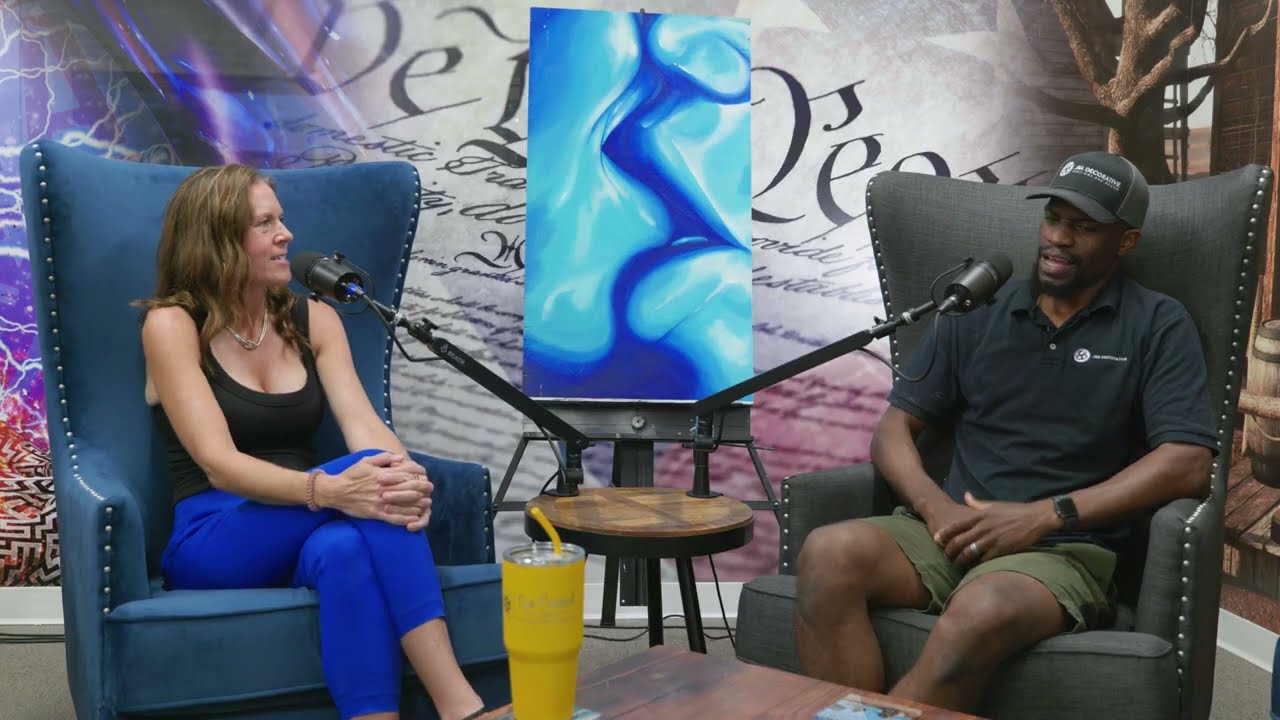
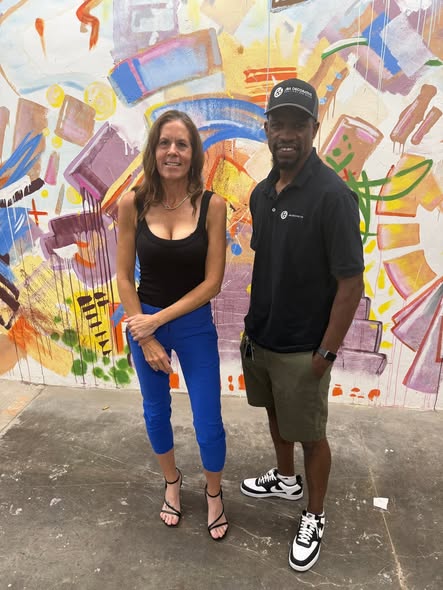
Hey everyone, it's Karissa from Shining Light on Minnesota. I have a very special guest today, Jendayi Berry, with us today. Welcome. Thank you very much for having me. You bet. So, let's get and dig a little bit deeper. Tell everybody about what's behind us. This is a piece called The Kiss. Um, obviously. Yep. Right. Uh it was just an exploration into um showing love in a way that um is illuminescent. Um so more more focused on the the difference between darks and lights and colors um tones and how you can represent just this moment between a couple that is so simple but um can be beautiful. Um and so that was acrylic on canvas. Um yeah and now we'll go a little bit deeper. So you love fine painting. That's one of your passions. Yeah. How did you get into that and when did that all start? Um, I really had a passion for it when I was younger. Something that I I was I grew up uh illustrating, so I would sketch in school all the time and picking up a paintbrush just seemed like this thing that was scary, but I really wanted to uh explore it. Yeah. Um, and so um when I was younger, I did maybe one or two canvases. didn't really uh commit myself to it. But towards uh the later in life, um I would definitely say between 2012, I was just really like, let's let's push this a little bit. Nice. Um started off in landscapes, explored portraits. Um I've kind of landed on abstracts, but abstracts with both of those things mixed in for sure. Y um so if I can have a portrait on top of an abstract, I feel like, you know, something that creates depth and that's kind of what I was talking to you about is like how could we backlight and have some layers to it and create this depth. So just constant exploration and what things can be. Yep. So you do the painting and you have a little bit of wallpaper business as well on the side. Tell everybody a little bit about that and Yeah. how that all goes. So, um I'll I'll do the full circle of the story is uh 2020 I really um started to push and get a lot of uh encouragement from the community as far as put your paintings up and we'll buy them. Yes. Um, so I would say between 2018 and 2021, I really just sat in my studio and and um uh began to get disciplined. Yeah. In creating uh paintings. Um had some great opportunities uh that came from that. But I also realized that the George Floyd um uh push Yeah. for um uh what do you call it? Equity. Yes. Uh was going to be short-lived. And so uh January, February of 2021, I believe, uh things started slowing down tremendously. For sure. Yeah, of course that's also retail season when everything kind of drops, but um I just know knew I needed to fall back on something that was a little bit more dependable and so I leaned into um interior painting. Um it was my dad uh was owned residential real estate and so I had a lot of experience painting with him. Yep. And uh I I also had worked for uh other painting companies uh in the interim throughout that that decade. And so um yeah, so the one side of my company is focused on interior painting and wallpaper. Yep. Um the other side is arts. So that is live illustration, murals, and fine art. Yeah. Um, I've done one one or two sculptures in my time. I would really love to to get really good at that. But what kind of sculptures were they and tell everybody a little bit about those. Yeah, it was um so there was a a an RFP uh for place via Soul in St. Louis Park um I believe off of Highway 7. And uh I won that opportunity. Um the sculpture itself was created out of rebar um in a helix shape. So I had to grout grind sorry dowel and grout those holes in to the concrete pad with rebar. I had to have the rebar twisted in a helix shape and then I impregnated um fabric cotton fabric with concrete. Very cool. wrapped it around that rebar, let it solidify, and then painted it white. The original sculpture was supposed to be made out of uh epoxy. Okay. Uh and it's kind of the same idea, though. It was epoxy impregnated fabric, but the fabric was black um cotton fabric with iridescent uh sequins. Mhm. So those sequins kind of look like scales, like fish scales at a certain point, but I had never seen um epoxy hold up in the elements outside. Oh, yeah. It's going to wear off and wear and tear, especially in the winter, spring, summer. Yes. Yeah, we have. So I was like, you know what? Maybe I shouldn't do this one. So I went back to the concrete, which is a little bit more durable. Yeah. But I enjoyed that one a lot. Yeah. So you have all that going and you have a family. tell everybody about your wife and what and your kids and every everything that goes on there. Yeah. Yeah. So, uh 20 um well, I have a wife, uh Joanna, Berry. Um and I have three daughters, um Jasine, Juniper, and Genevieve. Yes. Uh ages 19, 9, and six. Um we live in Richfield. I love my kids. Yep. Try to spend as much time. I really uh embraced uh the pandemic and all that stuff because I really got to spend time with my kids when they were younger. Take it in when you can. Right, man. And so um they're getting up there. They're they're the two younger ones are homeschooled and uh the 19-year-old, she's got a great job. She's a a nanny. She's got a good job. So, let's dig a little bit deeper. Let's talk about owning a business and what that's like right now for you with the shuffles. I know we've done some mentoring. We've done some talking about what it's really like and what the job market is like right now. What do you feel that with with subcontractors and trying to grow and things like that? What's been some of your obstacles? Um, I think as a small business, the bottleneck that I'm in right now is is the hiring phase, is getting out of the field. And, you know, I when I was working for concrete restoration company, the highest level that I ever achieved was a foreman. So, I don't feel like I'm um not used to managing people, right? But bringing in people to this thing that you call your baby and trusting them to the quality people to let them stay in their lane and run their own stuff. Yeah. And so that's the hard part and that's a bottleneck that I know that's not um you know unique to me, right? Uh, it's essential, right, to letting go. And I hear I hear so many entrepreneurs like, you know, that have gotten over that hump that are like, I wish I would have let go sooner. Right. But at the same time, it's still your baby and you want to make sure that you're doing it the right way. You've got to get the processes set so you can start delegating those hats. Right. Absolutely. Um, and so as far as job market, I there's there's tons of uh subcontractors uh out there. And you know, I have mentors in the painting painting world that are like, you know, you have to take ownership. There's no excuses. And the excuse that I can't find good people is an excuse cuz there are good people out there. And when you actually break down the numbers, y it's a numbers game. Yeah. Um, the hard part that I'm experiencing right now is the difference between a uh subcontractor that is willing to develop a relationship with you. Yep. Versus a subcontractor that just wants to make make money, right? And so far, I've had, you know, out of, again, it's a numbers game, right? I've had four subs, one I found that's really good, for sure. So if I need two to three more sets, something you can rely on. Yeah. That you can consistently say, "Hey, I'm going to be able to rely on you, but at the same time, I have to know that you're going to be able to get the work done on time, be prompt, courteous, professional, all of that." So I know that I can say, "Hey, here's another job. I'm going to hand it off." Not, "Are you going to get back to the customer? Are you going to be on time? Are you going to show up? Are you going to bring your own supplies? Are you going to be there?" Yes. Yep. Yep. I just had a guy, he just went dark on me because he kept switching the dates for when he could start. Y and I kept telling the customer, we have to push the date back. Yeah. And then I'm like, well, the customer hasn't made a deposit yet, so cuz he was asking for a deposit on the work. And I'm like, I don't I don't think that's the way the game goes. I think you do the job, you finish it. Like, y let's have a conversation. and uh he just went dark because I was like, we we have to do what's right for the customer, right? Here's the process. Let's get it done. Let's get it done. Yep. You know, I'm And so the the the sub that I do have that's working out, we we had this conversation and I think one of the keys is him saying like, of course, I want to be successful. Yes. But I care about relationships and I care about doing what's right for the customer. Correct. I don't want to cut corners, etc., etc. Exactly. Absolutely. And so I've seen that through his work so far is, you know, let's just do what's right for the customer, right? Um I think that's got to just be one of my qualifying questions. Like here's here's the number one question, you know, like is it the customer or is it is it yourself? You know, what what's more important here? Yeah. Yeah. So I'm learning through that process of best practices and I I started off kind of weirdly in the commercial sector which is not necessarily where people start out. Right. Right. And so jump the gun and here I am by myself and now let's say yes and then try to figure it all out on the back end. Right. Yeah. And there's a lot of the educational points that I kind of missed. And so I've I've stepped back to embrace those things, to learn those lessons, and I take it as a grain of salt, man. You know, now you know it. So now it's now it's a process, right? Yep. We'll be we'll be in a better position once I learn these things. Now that you're in the commercial world, when you go out for bids, have you had the time, like when you don't get them to go out to those contractors and be like, "Okay, let's let's find out why I didn't get it. Let's compare apples to apples. Let's have those conversations." Have you learned that yet? And have you gone back to them at all? I have not. I think maybe I've asked once one or two project managers or estimators like what h what happened. Yeah. Um the response that I got was kind of aloof. Yeah. It's it's cost usually just at the end of the day cutting bottom line. Um I'm a part of a um Allian Kson's Alliance program and so they're honestly super awesome when it comes to being trying to be available and do the right thing for their uh their contractors. Um there's a I consider him a mentor. He's kind of in line with me. He keeps we keep finding each other in the same spaces, in the same rooms, in the same opportunities. But Paul Edlin, um I just saw him yesterday that he was at the J Done thing. But yeah, Paul and all of them. Yes. Jay Benson Construction. Yep. Paul is he's definitely um showing me how what needs to happen in order to capitalize on the opportunities that we have. And there's a lot of people that are in the alliance that are going, "We want more projects from you." Yes. And what I see Paul doing is he's constantly knocking on the door. Yep. He's being a fly on the, you know, he's just he just keeps showing up. He just keeps showing up. And so that's something that I take to heart and I I want to try to implement is, you know, the hardest part for me has been being in the field. Yeah. It's hard to be in the field and network and do the admin and this. So, but to be in the position where I know two times a week I'm going up to Canudson to ask these questions. Absolutely. How do I bid this better? You know, I just got a thing from from Ryan Construction as a cool project manager over there. Yeah. She's given me like I'm like, "Okay, I just need to keep asking you questions." You got to ask the questions to know it, to understand, and then the contracts are a whole another beast, right? Yeah. Whole beast. Yeah. and then the bidding process and then all of their all of their just it's all it's all every company has their own way to do it and you've got to figure out how to do it and how they want it laid out. Yep. Yes. I think one of the things that I noticed that's um um pretty uh consistent across the board with subs that are in in my position and there are subcontractors that are way further in their their businesses than I am. Um but it's that that uh as u project manager at uh Kenson said it's the takeoff the takeoff ramp. Yep. and the position we're we're at to the next level sometimes in and I guess in our mind would like the ideal situation would be to have um a mentor or a a smaller GC that we can work under to see because to your point there's so many components to it and how do you how do you get me in the door to each company okay so they want it laid out this way here's their contracts here's how they want it out here's their bidding system here's how you have to do it for them, right? Yeah. Yeah. And I mean, even just even just on the requirement of how to submit something, I could be like, "Okay, I finally got the numbers from the here's how to submit the bid for this one, right?" Yeah. Okay. So, I think I did it right. Can you look at this and see if I did it right? Like, what am I missing? Yep. Here you go. Yeah. Yeah. And sort of have that that reassurance that, yeah, you're doing it right. You've done all the requirements. The number is decent. Blah blah blah. Submit it. That way you have the confidence. That way you know going into the next one now you know how to do it. And a lot of it is confidence to your point. Yeah. New space confidence. Well, you have the commercial side, you have the painting side. What is your passion? Is it more going back to doing that and having the other side once you get into the flow a little bit more having the other stuff kind of go on its own and be able to handle itself? Absolutely. Um, I think one of my goals is to establish a uh a painting business, decorative business that's one self- sustaining, but that can also provide opportunities um for people of color for women, for you know, like just people that typically aren't in the space. Correct. Um, and maybe that is through the subcontracting realm. you know, I can I want to help you make a million by help you help me. Yeah, exactly. Um cuz one of the things I notice uh in my research is that people in underserved un underserved communities, the root cause of the issues that we experience is economic. Um, and if we can get over a certain amount, you know, like we're not in a state of survival, right? Everybody's thriving, we can solve our own community problems. We all win, right? Yeah. Um, so yeah, to get to get the painting business self- sustaining to the point where I can focus on on this and and I actually had a conversation with somebody about, you know, do you see yourself hiring uh other muralists to do murals for you? You want to do the murals, you want everybody else to do the the commercial stuff. Well, and I I I think what I'm leaning into is there are so many opportunities in every single Well, and it depends on it depends on the project, but if it's a special custom thing that they want you in your work. Yeah. But if it's a big enough one, obviously you can have other muralists, too. Yeah. Yeah. Well, on the job, even if there's there's a mural, I I have a cool friend. Um, Made by Molly Joe is her her thing if you want to check her out. Made by Molly Joe. Um, but she has a very simplistic uh modern uh colorful style, super creative style. Yeah. Totally different. And I'm like the hotels and and you know certain certain spaces people just love her stuff or it's graffiti style or something different that you don't do or that you can't do or the the colors are just pop in different ways. Yeah. It's not necessarily my style, but the customer might like that style, and I would love to be able to capitalize on that and still offer that to them. How do you when you start getting in a grind or the commercial world, how do you refresh and reset to come back to being creative? I'm still trying to figure that out. I'm still trying to figure that out. I haven't painted for myself in probably a year and a half, two years. Yep. Um which is hard cuz like that's what you want to do. like, okay, you have the kid life, you have the family life, you have the commercial life. How do you get back to doing something that you love and just doing it for you instead of I have a customer that wants this or I have someone that wants that. How do you just focus on it and do what you want to do? And I I probably a bit more off than I could chew. Um I've allowed or I've um I follow the flow, right? And but it's combining your passion with work at the same time. I mean, it's combining the two things that you love. So, you still get to do it, but it's not I don't know. It's different because I do that with golf. It's like you're bringing your your passion into your work, which is great, but you're not doing it for you. You're kind of doing it for else, right? Yep. Yep. So, I just trying to figure out the I I talked to Robin Robinson um not too long ago, public arts council, and uh she was we had this conversation. And she was like, "People don't understand that when you're a creative person, you can't just create like that. You have to you have to find something to click and get all emotion." Yep. It's emotion. And sometimes that emotion doesn't come to the surface. Like you literally could be inspired. You could be Yeah. jackhammering in a poly tent and all of a sudden you get hit with inspiration. Go ahead. I got to go I got to go paint something. I got to do something. Yeah. Cool. I got to put it down right now. And so I, you know, I think being in a a spiritual place, uh, allowing yourself the time and the space to create, I haven't had that. Right. But I'm, it'll come back somewhere sometime. Yeah. Right. Right. When you're with the kids and in a really rushed hotel moment and all the kids want to go do something like, "Okay, yeah, hold on. Dad's got to go paint." Yeah. Well, I just had this live painting thing for uh for Target and I was like, I haven't painted in a long time. I haven't live painted in a long time. How is this going to go? And you start questioning like all of the history that you've had. And I got in that space and I painted and I was in the zone and I loved the final piece. People love the final piece and I was like, I can still do this. Yep. That's awesome. It starts clicking once you do it. It's like, okay, I haven't forgot how to how to get the strokes down and everything like that. Yes. I could still do this. So, have you ever gotten to a point where you just kind of draw a blank and you're like, "Okay, what am I doing?" Like, I got to kind of snap out of this. Yeah. You know, and I I think a lot of it is the same thing we're we've talked about is confidence. I got to rely back on that confidence. Like, you you've done this before. You know what? I don't want to burn myself out in the commercial world just painting up and down and doing the roller strokes and taping everything off. Yeah. Yeah. You know what to do. Yep. And I think that's important. The other part of it is surrounding yourself with people that are also going to reaffirm you. Yep. You know. Yep. Um I keep my my circle small. Yep. Well, and you have to. The people that are around you, and I've had this conversation more times than not, keeping the circle small and keeping the per people around you that want you to succeed and want you to win are the people that you need around you. There's too many people in life that don't want you to win and don't want you to succeed and don't want to help you out that you don't need like Yeah. having not really cutting people off, but being able to say, "Hey, there's a time and place for when you're allowed in the life and when you're when when you're ready." Yeah. Yeah. Well, I think it's also uh metaphysical level is just energy. Yeah. You may not intentionally want to see me fail, right? But you're not want You're not realizing through your actions you are depleting my energy level, right? And what is already on my plate is a lot that can take my energy. So like my mom is a great example. My mom will call me and she, hey son, are you busy? Uh, no. We're just What are you up to? I'm just doing this and okay, I'll I I'll let you get back to it. I just wanted to tell you. Y like that consideration. I can hear in her voice that she's being considerate of my time. Knowing I understand you're busy, but I just wanted to say, hey, I'm here. I've got you. We're good. Yes. Yep. That's awesome. So let's talk a little bit. I know we've talked before, but about how everything that you have on your plate and how you stay focused and how you keep everything going. I know we've talked a little bit about having the ADHD and kind of keeping everything in line and staying focused. How's that all worked for you? Oh man. Um, I think right now, and I just I recently had to reset because I started feeling super overwhelmed by all the tasks essentially running two sides, two businesses, is yeah, you do have ADHD and it's okay to take a break and to take a step back. Well, yeah, that and you need to just take inventory of what it is that you can do. what's necessary right now. All that other stuff, write it down. Yeah. The noise, it's like it can it can pile up. And that stuff that's step four, five, six, seven, eight doesn't need to be in your head. But not only that, you got AI right now. Like, how can you how can you use that stuff to take some things off your plate? That harder. Exactly. Or, you know, I think one of the things I I'm getting ready to do is hire a virtual assistant. um to take a lot of the admin stuff. So, making phone calls, yeah, um you know, scheduling um you know, sending out estimates and and all of that stuff. The the little stuff that doesn't need to have you there in person, right? And it's as my mentor, the mentor the for the painting business says, those are tasks that are um lower wage tasks, right? Yep. And you are stealing money from your family's mouth by spending your time doing lower wage tasks. Absolutely. Um, and so I have to keep reminding myself that, you know, if I'm charging $100 an hour, but I'm doing this, I'm doing that at $100 an hour when I could be spending time with them and they're growing up and they're they're getting out the door. Yeah, absolutely. What do you feel is important when you're meeting with people, when you're meeting with customers face to face, what are you seeing that the customers are really enjoying about your companies and meeting face to face? What are they what are they saying? Um, I think I've had some really And this year has been interesting because because I've started in the commercial world. Yep. And now going back to like lead sources and and cold calls and cold emails is just completely I do not enjoy it whatsoever. It's hard. It's a grind. It's a grind. But you have to do it. Like it's getting out there and people want as much as people don't agree with it, you still have to get out there and drop off cookies. You still have to see people. You still have to meet face to face. Yeah. And sometimes everybody doesn't always agree and just says, "Hey, get on social media and do something." No, you still have to get out there and see people. And that part of it is what I enjoy. I love the networking. I love meeting customers face to face. So, like that beginning part of it I don't like. But I just had this client that I walked in their house. Um, it's cute little old couple and they've got paintings all over the wall and the wife wants to redo the the basement and she's super corky and she's throwing out cuss words here and there. Yeah, she could have had like a hat a hat with bananas and a and a bird on it like this. That's her style. I love meeting people face to face and they I think they enjoy and you don't expect it like when you hear them on the phone you're like, "Oh, this is just a normal." And then you walk in there and you're like, "Oh my god, totally totally different than what I expected." Right. Exactly. Exactly. So, I think customers are um it's a mixed bag. I I meet every every 10 customers, I meet two really cool customers that I just click with. Yes. Y um I think the sales process is also one of the things that I'm learning. Mh. Um how key some of the questions that I need to answer are in that that uh initial right um building rapport, mirroring uh mirroring my client. I do that effortlessly, but asking for the sale or making sure that I met their need. Yep. With, you know, complete service. Um the followup and all of that good stuff. All of that. Especially the followup. You hit it right on the head. like, "Oh, boy. Here you go." Yeah. I gave you everything you need, right? I don't need to call you back and bug you, but I'm going to anyway. But I'm going to anyway. So, uh, I think customers are are perceptive um, as far as all of the things that I offer. So, part of my tagline is um, JBA Decorative from art to finish. Yes. Nice. And I realized that I think one of the benefits or the things I've seen from customers is that they don't have to go to an out another contractor, right, to get certain things done. Correct. So, this this specific client um has tons of stuff in their living room. Yeah. And we're going to reinstall or rip down and install new drywall, paint everything, mud everything, the fireplace. So, we're going to um tack in new 2x4s, new studs, drywall that, wallpaper that. Very cool. Um she's got she wants to do a pink glittered epoxy floor in her bathroom. Absolutely. Um and then give her some new paintings in the basement when she's all done. Why not? Right. And so I had to literally tell her like cuz she was like, "We might hire another company just to do the epoxy cuz Oh, yeah. No, I'm good. I got it. That's one of the things. We'll figure it out. Yeah, I've done it. You don't need to go anywhere else, right?" Um, even for the moving, but we got labor that'll help you move your stuff. You know, one-stop shop. You do it all in house. That's the important thing. Our customers don't always know. I mean, especially the ones that are listening, that you do everything in house and you're the one person. It's not I'm subbing this out and I'm doing this. You do have subs that help you, but it's it's you. It's still my team. Absolutely. Still my team. I want to make sure that they're providing quality um and they get where we're trying to go. Y um you know, we've I want to bring bring my team into back into the commercial world. Yeah. Um, and so, um, we have to, you know, we have to get really, uh, dialed in with knowing uh, where we're going, what the customer needs, etc. And so, we're getting there. I think knowing what the customer needs is one of the biggest things because you don't want to go in there with too broad of an idea. You want to know them enough that you give them less is more. Just give them what they need. Yeah. Yeah, exactly. And it's e, you know, like the what I'm realizing too is that the value you bring to a an experience being the expert. Yes. Yep. Seriously, senior to sales. Yeah. And so it's not I a lot of I used to go into a space and go, okay, so this is what you want? Yeah, I can do that. I can do that. but actually doing what's right for the customer and being like honestly you don't need to do that right now. You have to be confident enough to know what you're saying and they get you, right? When you're selling what you're selling, they're getting you. So, you don't want to be the low one because you're standing behind your company. It's you, right? It's your baby. So, yeah. Well, and they just even just on the sales uh and and rapport situation building trust when you say you don't need that or that's not necessary or these are the products I would recommend instead, right? This this finish doesn't actually when you give that little bit of push back, you're giving education, but you're also building trust because you're saying I don't I'm not trying to make necessarily just make money off of you. You know, I want to make money. Obviously, I'm in business, but I care about you. It's not necessary to do that step, right? I care about you. Yeah. So, what is your why? What's your driving force behind everything? Um, I feel and I've always felt this is that when a company has a mission statement that lasts for um I think Starbucks I can't remember what Starbucks mission statement is. It's a pretty good mission statement when you think about it holistically. Yeah. It's so broad though that you're almost Like if I were a spaceship, my mission would be to go to the moon, right? If I just said my mission is to um solve universal issues in space one day, like what does that mean? What does that mean? And so every single there's a different layer to it. There's so many layers of missions that we should have. My current mission um is to get to a certain level. Yeah. In my life. Um the next mission would be to use that level to benefit the community. Correct. To also solve issues. Um I might have two two missions going on at the same time. I want to go to the moon. I want to collect moon rocks and I want to s send that back to be analyzed for Yep. for the next mission. Right. for the next mission. And so, um, you know, right now my mission is just to create a million dollar, multi-million dollar decorative company. Y, um, while still maintaining, yeah, still maintaining uh time with my family. Um, and then my mission after that will be to do the same thing with my art side of my company, create time, etc. Um, but there are a lot of community issues and especially that are being highlighted right now by the current administration that I would love to assist with. Yeah. Um I think now is the time to um use my voice uh to document what is happening. Mhm. And hopefully the next generation like I really want to um see the see see the true story through all of the noise. Yeah. Y and we as a people continue to repeat history in an age where technology you would think that we would be way more advanced, right? That part should be the most scariest to us is we're creating an an intelligent sentient being and we haven't we haven't we haven't grown. No, no, we haven't. Right. It's all the same. Right. Yeah, technology is there, but we're still people and we're still doing the same thing. Yeah. Yep. I mean, like I I used to have as an artist and I sometimes I go on weird tangents, but I I I believe we are capable of way more than we think we are. Oh, absolutely. And I grew up in in the church. And so when I saw Christ doing the things that he did, I was like, we are capable. Yeah. And I think that was the main point of his his his mentorship is to show us what we're capable of. We haven't even touched on it as human beings. And so if we can like fighting about that's my toy, right? Let's grow up. Absolutely. And be kind. I mean, there's so many different avenues and so many people doing so many different things in the world. You've got to just get out there and make a difference and Absolutely. do things. Yes. Absolutely. I know there was someone kind of to go back on your whole part about your why. There was someone that I just had on that she said when she teaches people about her why she reassesses it every six months because there's three levels to it and she said that the there the first level is kind of very generic and every six months when you reassess you should have three different layers and that's kind of coinciding with what you said. She taught psychology and she you know that's one of the first things that she said. So if you have your first layer, then dig deeper for three more layers after that and do that every six months just to kind of think about what your real driving force is. So kind of made sense. Yeah. Yeah. I actually have a a thing. I haven't memorized it yet. I'll pull it up, but I'll let you ask ask your next question. Mentors. Who have been some of your major mentors along the way? And who have been some people that have made you who you are today? Um man, so many. Um Susan Campion. Um she's a connector of people. Um she introduced me to um uh Tim Timothy Foss. Uh Timothy Foss uh was my mentor for live illustration. Yeah. He still sends me opportunities. I I have something coming up with the Best Buy because Tim Yeah. Um uh let's see. Anybody when you grew up that shaped you to kind of who you are today? Um well definitely my mom and my dad. Yeah. Yep. Um, I think I I I I didn't realize that both sides of my family, but especially my mom's side of the family were so entrepreneurial. Oh, nice. Good. My granddad or grandpa owned multiple businesses. Very cool. Um, my f their their her kids um were always trying to hustle the generation that came after. Um, so it's kind of in your blood. It's in the blood. And I didn't realize that. And so I um I I used to always question though, like why do you want to start a business so bad? Yeah. What's in it? Why? Why me? Why? What's there? Yeah. Is that really like And I just I don't know, man, but it just feels right. Like I don't and I actually had that conversation with my wife uh when I was pushing for entrepreneurialism and I was working for another company. Of course my wife working for corporate America somebody else or should I just do it for me and I think it was kind of us learning and growing together. But the the idea of like are you capable of doing that? Is that really what you want to do? And are you showing the things? And I I was kind of basically saying like the reason why you're maybe not seeing um my entrepreneurial excellence working for somebody else is because I'm working for somebody else. Yep. You're not seeing me grow or be the person that I can be should be. Absolutely. And the only way you're going to see that is if I do it right. You know, and I think within the first year she was just like blown away. Yeah. I guess you can do it. I guess taking on more than I can chew, but I'm doing it. All right, brother. All right. Yes. So that feels really good. But it's almost like that, you know, classic Disney story of the person that's not doing what they're supposed to do and they're but then they me I'm just there. You just need that catalyst. Now I'm there. Now I'm Michael Jordan. I'm good. Right. Exactly. Yeah. Yeah. Um it's kind of interesting though like when people do that. I've had a lot of people in my life lately that have taken like big life jumps with work and they've always been held back by something or another and all of a sudden they're like when is the right time? Mhm. I'm like, it's never going to be the right time. So, either you're going to do it now or you probably never will do it. Yeah. How or what made you make the decision when you did it? Just having the discussion with her. Uh, we danced for a long time. Um, I think I needed to see um a little bit of discipline in myself. So when I would come home from, you know, jackhammering concrete or whatever, I would come in the studio and paint. I got to get the grind out at home to know that I can still do this and this together. Probably one of the biggest things about being an artist is finding your voice. Yeah. And I love inconsistency, right, as a person with ADHD. So consistency wasn't appealing to me, right? Um but I needed to have a little bit of consistency to build confidence that I can do it. That I can do it. And um so that was a huge uh turning point. Um you know there was u a couple articles in MSP magazine. There was uh uh got a call from uh Midwest Home magazine. Like there was a lot of press that kind of built up my confidence. Um huge opportunities came thereafter. Um and so that built confidence. I also had a guy that was um that I was painting for. He's the guy that introduced me to wallpaper. Nice. Wouldn't have thought about it at all. Um and I had said something like, I don't know if I should leave or not. I don't know if I should leave concrete or not. Y you know, because what did I say? Because Oh, because we went union. Oh, yeah. And I was like, I got benefits now and you're making this wage lining up. Y Yeah. They could retire on this. And he was like, He said, "You could wake make way more money working for yourself, right?" And how confident he was, I was like, "Huh, okay, then. I've got this. I'm going to do it." Y and honestly, like I literally I was I just had this conversation with um somebody in my BNI group, but I was on the fence and I was praying, God, just I know that I know this is crazy to ask, but I just need a year of time that I don't have to work. I can focus on my artwork. We can be financially stable. Y I did not expect the pandemic to be that answer. Not not shifting that way, right? Yeah. Yeah. I don't quote me. I I didn't pray for that either. I didn't pray for that. Uh, but I literally got a year, if not more, of unemployment, spending time with my family, diving into my artwork, um, and and and working on this business, and that's exactly what I needed. And now it's all flowing. And look at you now, right? Yeah. I I I feel extremely blessed. And I want I've I think something that the wealthy realize is that you can't not everybody can be pulled into this space. Not at all. Everybody has their own lane and a reason for where they're at. Right. And it's just like where you're at. I wealthy people talk about mindset all the time. And I can see how I didn't have the mindset. because I was one either making excuses or the mental clutter of I can't or I'm here. I'm I'm stuck. And I've tried to already I'm not even where I think I should be, but I've tried to pull certain people in to this space with me. And they're in and out or they, you know, my first hire was this young kid who was even talking about his generation. He was like, "My generation sucks. Mhm. We don't know how to work at all, blah blah blah. And I was like, well, obviously you're but it's a different type of work. Like they might know things quicker technology-wise than some of the other people, but they're kicking out stuff that the older generation might. It's a different type of work. It's a different kind of mindset. And he I'm not throwing him under the under the bus at all. We're talking about different generations is all. Yes. Different generation. uh when you're working for somebody else and you ask them if you can be on your phone and you say for emergencies. Yes. And then they put their headphones on and are having a a a speakerphone conversation in front of a bunch of customers and you're like, "What are you doing?" Yeah. The phone thing is a total Yeah. That's Yeah. Mhm. you know, so there was just things that like I realized there's a you can't pull everybody into the space, but those people I do want to bring in, you know, and there are people that are meant to be and there are people that you live and learn from, right? Everybody's meant to be where they're meant to be. Yep. What do you think is next? What do what's what's on your plate next? What do you want to see happen with your business? And where do you how do you want to grow? Um, I think what's next is just to follow this plan. Um, I I got an a um an investment from a nonprofit called NIF New Impact Fund. Um, myself, Paul, a couple other business owners. Um, and that capital. Um, I'm I'm more conservative when it comes to getting money that I have to pay back, right? And so I'm like waiting for the right I want to make the right moves and invest in invest in the right thing. Um so this next year I'm gonna invest in um uh Home and Garden Show booth there. I've talked to a lot of contractors that are like I booked my entire year out. Yep. Um I'm going to book uh I want to have a full plate of residential work. I also want to um network with the current relationships that I do have. Absolutely. So Ryan Jun, I want to the contractors. Yep. Yep. Um and not be so honestly there's a part I used to not be afraid of commercial or federal work. You just got to know the lanes and how to do it. I think it's understanding, right? They call it shiny object syndrome and you can do something that you haven't proven to yourself you can do or you don't know the language. Yeah. Um, so I've become more afraid of making mistakes in that arena. I'm I've been reassured. Um, over time though, I think that you don't have to be so afraid, right? Um, you just need to ask a lot of questions and work network with people. And um, so I want to do a a lot more of that. My goal is to have five relationships that I can, you know, make a $100,000 off of and provide quality work for. Have the residential side rolling. Um, I want to get the public art side automated. Yes. So, our RFPs, RFQS, uh, cold emails. I want to get a lot of that automated um uh assistance from my VA to fill in a lot of the admin gaps and then start hiring strategic people. Yes. Um to really take on a lot of it. Yep. Um so you can start staying in your lane and do the stuff that you need to do to help grow like Absolutely. As a business owner, I think I know I've talked to other people and our audience has probably heard this more times than not, but you need to be able to do your role as an owner or other people need to do what they need to do as a non-owner, right? So you can grow. Yeah. And I I I think I realized like um No, no, that's a mood point. We'll go somewhere else with that. Yeah. But staying in your lane, not wearing too many hats, just staying focused and be able to do what you need to do. For sure. Yeah. And I think that's a detriment to the the company if you're spending your time doing the thing that you're not. I don't want to be doing admin when I should be growing. I don't want to be doing admin when I need to be out there with customers. And I don't want to do the hard commercial stuff when I have customers that are wanting the the fine art stuff. You know, it's just kind of one of those you got to do where where you're meant to be. Absolutely. Yep. Yep. So, we have your commercial side, you've got your business side, you've got your family side. What's next for the family? Do you have any trips or anything fun coming up there? Uh, we have we're going to do a week's stay at a hotel uh in uh Lakeville. Uh my wife, you're going to love that. Wife just had a birthday. Um my middle child just had her dieversary. Um and so we're going to spend time there. We've We love to do the little small stations. We went to um what is it? Two two harbors. That was awesome. Absolutely. All the pink beach, the black beach. Just getting out of the house and doing something out of the norm. Even if it's just a day or just a couple hours, getting getting time away from that. Yeah. Yeah. My number one place though my wife knows is Hawaii. Um Big Island or where? anywhere there. I don't know enough. I was supposed to go to college at uh University of Hawaii at Monoa. Okay. So, I think wherever that is, I want to visit. I'm going there and I'm not going to come back. I'm going to be on the beach painting. It's I'll I'll be good. Yes. Yeah. I mean, I literally that that I I paint I started painting a picture of my end vision, which was to be on the beach painting while my family is my kids are playing in the waterground. They've got their partners, you know, uh a little cabana. My wife's just relaxing, reading cuz she loves to read. I feel like she's a she's a writer. Yep. Um, what kind of writing does she like to do? She Oh, she's a great writer. She's just hasn't built the confidence that that's what her calling is. That's what I see for her. She needs to do that. Yes. She loves to read. The kids are doing their thing. You're doing your thing. Y she loves to read those. and she loves to read like anything from uh fiction to romance to uh uh murder mysteries and and um you know she she loves the the fiction stuff. She's always getting Why are you why are you reading that? Yeah, self-help books. I'm reading cuz I I'm I'm Yep. I'm learning right now all the time. If I'm not if I'm not doing that, I'm watching YouTube videos learning. You lose it, you lose it, right? Yeah. Yeah. Yeah. So, so bucket list, obviously you've talked about Hawaii. What are some other things that you like to do outside of work? Um, outside of work, it really is. It's work and the kids and the family probably. Yep. Yeah. But lately, it's been VR. We got a um MetaQuest uh three. And I kind of resisted this whole virtual reality because I just feel like technology, this this whole thing about like enjoying reality, just be reality. But you could pull that into the painting side. You could pull that into the wallpaper side down the road saying, "Here's here's what your image is going to look like on your walls. Here's what it's going to look like down the road." You know, the 3D 3D imaging, everything like that. Yes. And I've used that for murals. Excuse my alarm. um is to take the image and see it, put it on the wall. Now I can sketch it out. Exactly. But I've been playing uh PvP games, player versus player games. Um and and I really enjoy that. So yeah. Nice. So we've talked all the stuff. We've talked the workshop. We've talked the family stuff. Favorite food? Oo. Oh, that's so hard. I actually haven't asked as asked that question answered that question in a long time. Um, I love fruit. Mhm. Uh, right now my kick has been um watermelon. Uh there's this melon called um something soul something something soul and it's looks like a football. It's green on the outside and you cut it open and it looks like uh like a cantaloupe or a um a honeydew melon. Okay. But it's so sweet. Nice. And so I've been trying to get on that kick um with melons. Y I think that's part of like a cleanse like my my health history. Y um I always struggled to drink water. Mhm. But I always felt internally that the recommended amount that we should be drinking daily was not necessarily true. Right. in the sense that I think what you should be the water intake your body requires is typically had through food. Correct. Y and so I saw this one guy and I think I don't know if he's in Honduras. He he reminds me of Dr. Sebie, but he was like, you know, the majority of the your water intake should be through foods. And I was like felt so reaffirmed. Yeah. Just ding ding light bulbs there, right? He's like, you know, water in itself, unless it's H30O, is just empty. It's it's hydration, but it just keeps your body stable, right? Um H30 or or uh water you get from melons is infused with vitamins. It's been pulled directly from the earth, all these minerals you need. So, you're getting way more out of what you're drinking than regular water. And I was like, said. Well, and you talk about food, like when people want something sweet, they're actually needing sodium. You know, it's kind of one of those vice versa things like people don't know the real genetics behind food, too. I mean, we could get into a whole podcast about the food and water and everything like that, too. But yes, I mean, it's just kind of one of those. The natural and not having caffeine and not drinking all the water. It's all going to come out anyway, like if you drink all the water. So, it's Yeah. Yeah. Yep. There was a a conversation KRS1. I don't know if you've ever heard of KRS1. I have. Yeah. KRS1 is so metaphysical, but he was talking about um the relationship with the body and literally having conversation with your body as it's as if it's its own entity and say, "Body, what do you need today?" Right? Oh, you need to rest. Okay, let's sit down for a second. Oh, you need a bath. Let's relax. But on a chemical level, if you can actually see, if I could see you being made of chemicals through my eyes, not flesh and bone, but chemicals. Y and the requirements that your body is saying I need in a as a chemical entity. Yep. Hey, I'm low on sodium, right? I'm going to take a test and tell you what I need today. Yep. Yeah. Yep. Oh, hey, I'm low on, you know, potassium. Oh, I'll give you I'll do your labs today and I'll tell you exactly what you need today. Yep. And so I see I see the medical field going towards there. It's so expensive. I've done the blood test, the poop test, you know, send it in and blah blah. And it's like we can send they'll tell you exactly what you need. Like here's all your Yeah. Yeah. We can send you all your vitamins and blah blah. That'd be so crazy. But $200 a week. Yeah. Yep. Lord Jesus. Yes. Exactly. You know, but people do it and it's getting to that point. And it's like here's here's how you process your foods and here's the foods that you need and here's here's all the medical ways to prolong life or so it goes right. Yep. That's so it goes. Right. We'll see. We'll see when it or how it really works when you get there. Yep. Yeah. So, we've talked everything else. How can people get a hold of you and what how where are you being or where you where can they find you? That was a whole hard one to say, right? Wow, that was difficult. Yeah. Where can you be found? Where where are you? Um, I'm on Instagram at jind e berry art. J E N D A Y I. Again, that's J E N as in North, D as in delta, A Yi. Berry, B R Y, art. Uh, at Jenberry Art. Uh, website www.jindberryart.com. Um, LinkedIn, Google search, just search for Jendayi Berry and they can buy some of your Do you have any art that they can buy on your website? Currently, I do. I stopped selling originals on the website. Um, I have prints. Um, those prints are essentially custom though, drop ship. Yeah, they're custom works. Um, I would say the best way if you want something custom is to reach out to me, DM me via social or send out uh, we'll have it in the link after this and we'll put it on the podcast as well. Everything will be on there, too. Beautiful. Yep. And they can get a hold of me if they need to, too. And we'll we'll get them in touch with you. Awesome. Yes. Well, we appreciate having you on today and look forward to all the conversations in the future and growing and collaborating. Awesome. I do too. Thank you very much. Um, so my purpose is my truth. As above, so below. It is my essential belief that the natural world gives us great insight into who we are, who we were, are, and can be. This macro micro perspective is shared by many who understand the universal truths and laws that govern the dualities of our existence. It's all relative. And yet it is within our in our nature as bodies of water and beings of light to muddy and distort our reality. Through my work, I seek to tell stories and give examples of these distortions in an effort to neutralize the noise, correlate perspectives, and ultimately clarify some level of truth. And so in each one of those, there's some key words in there like duality, water, um, perspectives, distortions, light, universal truths that I want to highlight through specific collections. Yes, that'd be amazing. Yeah. And each one of those things to her to her point is like a level within that for sure, you know, in that why. And it's like, yeah, that's cool. That all makes sense. Yep. Yeah. Wonderful. Perfect. Thank you. Yes. Thank you. [Music]