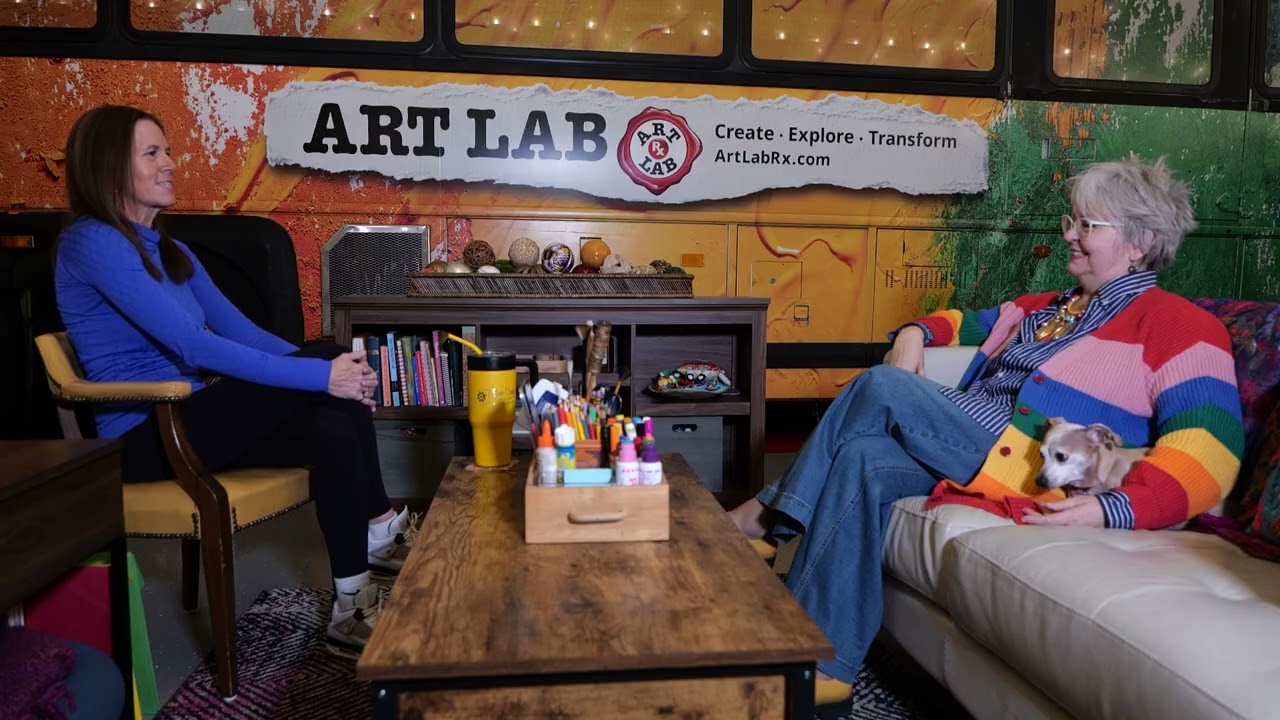
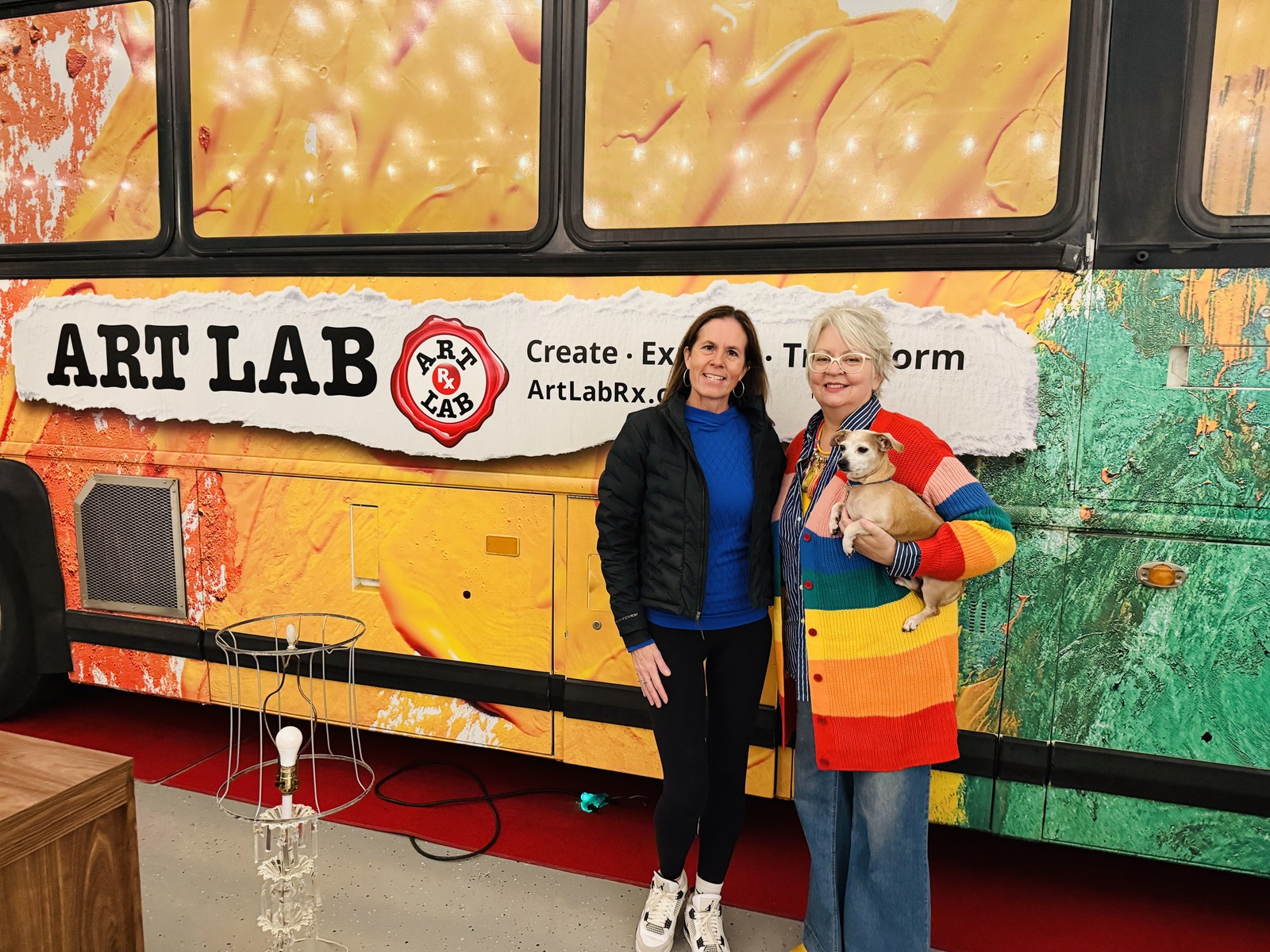
Hello everyone. I'm Karissa from Shining Light on Minnesota. I'm very excited. I'm in Blaine. Everybody knows Blaine because that's where we're at. I'm with Lisa from Art Lab Rx. Welcome, Lisa. Thank you. Thank you for having me. Yes. So, let's get started and tell everybody a little bit about Art Lab and what it is. You are now in Blaine and that's super exciting. It is. We've just moved here um to actually in January it will be our third year. Wow. Amazing. This has had quite the transformation. Oh my gosh. Transformation is the main word for our agency. Yes. This went from a machine shop to the wicked cool art therapy studio that it is. Yes. And when we're done, we're going to give everybody a little bit of a tour, too, to kind of show them what it looks like. Fun. So, what is Art Lab for the people that don't know? Art Lab Rx is a mental health agency and we specifically focus on art therapy, art therapy services and we do wellness workshops also. Amazing. How did you get into Art Lab Rx? Well, I started out um just as a kid doing volunteering for underserved populations. I've always done art. I've had art galleries and all different kinds of things. And as uh a married woman, I was unfulfilled in my job. Yeah. And it's like I I I need to go and be who God made me. Yes. And do what I was called to do. But I didn't know what that was. And um when I lost my corporate job, Yeah. I knew that I needed to go and be an artist in some form. And then when I did a healing art workshop for a group of women in a treatment center, their response blew me away. Their response was amazing after um a 2-hour workshop. And I knew that this was juicy. This was heartfelt. This was real. And I wanted to do this kind of work for the rest of my life life. But it was bigger than me. It was beyond me. And I knew I needed an education to support that. For sure. So, what are some of the processes or what are some of the things that you have here that people can do part of the art therapies here? Um well we're sitting in the area where we would do individual where couples families and all that's through insurance. When we take Maggie, the bus that is right here behind us, when we take this 45- ft coach bus out, we can do groups on Maggie. Uh, and that's either for up to eight people or we have easels where we could do a group of 12 people with easels. In um in back of us, we have a whole group space. Okay. And we do open studios on the first and third Friday evenings for the general public. And you don't need to be in therapy for that. You just come make art. Yeah. But also one of the biggest things that we do in the larger group area is we do team building. Ah very important. It's very very important. And it's such a different way of doing team building because you get to break things. Yeah. And then as a team you put it together infusing hope and healing with some of the pretty things around what you're broke. What do you see? Cuz I know a lot of people there are a lot of break rooms out there but when people break things then they put them back together. This is this is not a rage room. So rage rooms are great for fun. Um my problem with them is they kind of leave you in that rage state. What we do is we allow for reparation, restoration and we take that brokenness and we help you to gain a different perspective literally reframe your concept um by creating beauty from that brokenness. Amazing. Yes. So, it's beyond way beyond that rage state to go to repair. I forgot to tell the audience who's sitting next to you. Oh, this is Charlie. Hi, Charlie. [laughter] The most important part. Yes, he is my buddy. And it's the clients love him. Even the ones who are not really all about dogs. He doesn't go up to clients except when I go to get them in the waiting room. He will look at them. He'll sniff them and then he'll show them the way to come into wonderful group. And then he just usually is sitting like this next to me cuz I'm usually sitting in your chair, right? And or he'll curl up in my lap and he'll want to get under a blanket. So he just stays all curled up with me. Perfect. So you have some visual areas in the back for people with autism and different visual impairments as well. tell people a little bit about that. Sure. That isn't the only area of accommodation. Yes. That we have. Um our eyes spy wall is also our tool wall. Yeah. You have to put the tools somewhere. So, might as well have fun with it, right? And we also put little circles all over the place in amongst the albums. So, we have albums on the wall. And in these circles, we have little trinkets. Yes. Little things, little bubble gum machine typeiz things that you would maybe find in a junk drawer that would be in a kid's pocket. Y and we might have three or four different things to have them look for. So it's a seek and find I spy wall. And so that's really wonderful for people on the spectrum. Yep. Also, what we have in the back area is a splatter wall. So, that's fantastic for people of all ages. Yes. For all kinds of reasons. Then we also have a bilateral scribble wall. What I mean by that is that people will take um a hard crayon or a hard thick um graphite stick and scribble with both hands at the same time. So your left hand is activating your right hemisphere, your right hand is activating your left hemisphere. So you are getting a bilateral brain stimulation while you're scribbling and drawing and it's very regulating. Yeah. Very soothing. So you have all of these pieces here put together so people have anything that they're going through, they can they can release it. You also have a place in the back for the noise and the stimulation if it is too noisy. So they can start out there and then get to the other part. Tell a little bit about that area. So the cozy corner is where we have this fantastic 14t tall weeping willow tree that we designed and it is cascading. Sorry, Charlie. It's cascading um down over a hammock. Good. So, there's a hammock, there's a a large papaon chair, there's a rocking chair, and a foamy bean bag kind of chair. And all this area can be for um when someone needs to self-regulate. If the stimulation is a little too much out here, perhaps we have done some trauma work here and then we may go back there for the last five minutes and just go through a a guided relaxation process to just cool everything down, calm down. Um, sometimes we might have the whole session there, right? It all depends. If someone has really high levels of anxiety, they could be in the rocking chair and I would guide them to rock and as they're starting to rock too quickly, I'll be slow down. So they are aware. So it helps increase awareness of what their somatic cues are. Yeah. So what's going on with their body? They're more aware of what's happening subconsciously. And so we bring that to the conscious by using that space. Yeah. And a good story about that is working with um teen boys who were in a um very light security um detention center and they came here and we did mask making with them. Fun. It was so great. And the last 5 minutes we went to the cozy corner [laughter] and I put on kind of spa soothing music they would fight for who got the hammock. So we had to take turns and make sure that was all very democratic and they they each got their turn and we just relaxed and we allowed space and time. It's important for them to have that too cuz they don't always get that. Many of us, many of us don't get that just go go and we're inundated with images all the time. So many sensory inputs that we need this to reset, relax, recharge, then we can go. At the end of those five minutes, the boys would say, I don't want to leave, right? I can come back. We can do this again next week. Yes. So tell a little bit about your story. I know you have quite the story to tell. I have quite the story to tell. Um, one of the projects that I do is where um, we put down the texture of our past with tissue paper. Yeah. And I have a lot of texture. Yeah. In my has a story to tell. Everyone has a story to tell. So, um, I just c a part of it. There's there's way more to the texture, but part of what I will share here is that I just celebrated 20 years of continuous clean and sober living. Amazing. Congratulations. So proud of you. One day at a time. One day at a time. And that is amazing. You know, it's what I feel my my hierarchy so to speak. It's like God first. Yes. Then recovery. Yeah. Cuz if I don't God brought me to recovery and if I don't have and recovery is different than just being sober, right? So I'm actively moving forward in life doing things about recovery. And that's one of the big things that we do here is work with people in recovery and help them actively do something. You have to have something something to do about recovery and then um after um the recovery then it's everything else cuz I would have none of this. I would have none of this right if I wasn't um clean and sober and I mean there is domestic violence there's um rape and abortion pregnancy there's um different living in different countries and being um being nearly arrested in a different country and um learning a different culture. So many different layers. So much texture. So much texture. And the beautiful thing about that texture is that one, there's really not a lot that surprises me anymore. No. Right. And the which is a really good thing because people can sit here and be really afraid to tell their story, but when they do it doesn't surprise me and we can go there. Yeah. And we can work through it. They expect a reaction. They expect a reaction. Yeah. But when they receive compassion and understanding and I may even have been in that same place and let's try this. You want to try that? Maybe you need to burn something. Do you want Let's do that. They bring it to the table. Yeah. They're so surprised. And then when I don't shy away because I've had so much texture in my own past that I can meet them where they're at. Yeah. And often times they don't expect it and then when they get it just like this one just did right here. They calm down. They let their guard down. They let their guard down. they drop it and they can allow themselves to be vulnerable with me because they know that it's okay here. It's a safe space. It's a safe space. One of my clients even said who was sitting right there and he said, "I feel more comfortable here than I do in my own Ed, which is scary, but it's Yeah, he does live in a group home with other men. And what a statement to hear, right? I mean, it gives you like the chills. It's like one of those that it's amazing to see the transformation. There's the word. Yes. When clients come in to how they change and then from 10 out of 10 intensity of suicidal ideiation to in the same session. I'm excited to come back here next week. Can which is amazing. Yeah. cuz you know what you're doing is making a difference. It is. Yeah. Making a difference. Absolutely. What have you learned from the time that you've been here to now as far as mental health and things that have changed with people these days. More and more people are aware that therapy will help. more and more people, especially since the stress of COVID and staying home and that um kids need help and it's okay, right? And more and more people are willing to come to therapy where they may not have in the past. Um and more and more people are aware that there are alternatives to just talk therapy. So I'm a licensed marriage and family therapist. I am also a talk therapist. Right. However, I lead with art therapy because it will break down walls like nothing. I've ever seen. Yeah. So, there is a very high need. The levels of anxiety and depression have just gone through the roof. And we've got waiting lists, but we also have new people who are building their um case load. So, unfortunately, the clientele is not going away, right? Yeah. But there's also help. Do you think that there's an overstimulation of people wanting to get on medicine right away just to get on medicine or do you think that they want to have the therapy first before they try to get on the medicine? I think um I think there's an overwhelming desire to be released from pain. Mhm. They need they need the help. They know they need the help. Yes. People want to need relief. Um I'm and people are going to search it in in very different ways, right? Any way that they can get the help, right? And whatever is most what seems most efficient for them, they may go that route, right? Um the thing about therapy that's interesting is sometimes it feels like it gets a little bit worse before it gets better. And there is a risk y when you go to therapy because you you're talking to someone you're letting it out. Yes. Yes. It's going to come full circle, right? And so when someone enters into therapy there's information it's going to get heavy. It's going to get heavy. And sometimes people don't always realize that that vulnerability is necessary before they get better. Yeah. Yeah. Do you find that when people come to you, they fully understand that before they come in, or do you find that they think they want the quick fix, like I'm going to come in and have talk to you once and then it's going to be better? Well, they could. Yeah. Um to them, right? They don't say that outright to me. But what I make sure of is that everyone who comes in has at least three coping strategies before they walk out the door. Wonderful. And so I had one um teen client and so my mo for my first session is to go through the paperwork, make sure that we have everything correct and anything that I need doing that you know the administrative stuff first and then we have so that's about the first half hour and then the second half hour is let's do a little let's do a little more discovery so you have a teeny idea of what our therapy is like and make sure you have some coping strategies to handle life before you go back out the door. And this teen client, we tal I asked her about, you know, how does she handle her stress at school? Mhm. And she didn't know. And I said, "Okay, well then then let me teach you at least three things right now." And so I taught her three different ways that she could cope manage or cope with it um without using anything just with her breath with her fingers making circles or different kinds of tapping or different type of hug or things like that and she almost got a little bit angry towards the end. I was wondering like what was that about? And she said, "I learned more from this one session than almost a year with my other therapist." Mhm. It's like just see you next week then. Yeah. You're at the right place. You're in the right place. Yeah. Let's keep going. And this is not against other therapists, but I I really You got to find the one that works for you. You got to find the one that works for you. And um and everyone has a different style. Yeah. And so you just don't know who or what's going to work for you. And that's my style to make sure they have some some tools before they leave. Yep. So what about the internet? I mean obviously through co you had to do a lot of online type coaching and how difficult was that? Did a lot of taotherapy. Yeah. Mostly the taotherapy. Well, the only way I do taotherapy now is if I have seen the client face to face for a number of sessions and we know each other. Yeah. So if they're sick, whatever the situation might be, then we'll do teleapy. But before um here was one thing I think there was a very good example of how taotherapy can work. Highly um anxious client. Got it. Scared to even get on the phone. Finally got on the phone and I was just real human. Yeah. on the phone with her and had a couple discussions on the phone. Yeah. And then get him in the door. Willing to do taotherapy. Oh, got it. So, we did taotherapy for quite a while. And then it was okay to come in and then she came in. Oh, wonderful. And so that was a very slow progression into face tof face therapy. Yep. But that's how it needed to go for her. So just to get her to release and kind of get her comfortable. Yep. That [snorts] Yeah. I'm Yeah. in a way that you can do it to just help them out. For sure. Yeah. Being real. Yeah. You have to be real and you have to be who you are and any way you can help them to get them the help they need. For sure. And I'm not for everyone. No. Right. You have to find what works for you, right? Yeah. I think that's important. I mean, a lot of times people say, "What what would work for me?" And who knows what that may be and who knows who that may be. But realness for one might not be real for the other. You've just got to figure it out. Well, and usually if someone asks me that question, I'll ask them what didn't work. Right. What have you tried? Yep. That's it. So you had and I know this because I've talked to some other people. You had a little bit of sickness there. A little about with the sickness too. Yes, I am um three years in remission from non-hodkin lymphoma. Actually had a a checkup this morning. So I have a clean bill of health and I don't have I know. Praise God for that. It's just amazing. Um, and this was a really scary thing because I went in for a a torn labum. There's noise in the in the area next door. A I went in for a torn labum in my shoulder. And this um tendon that goes down to the bicep and I knew what it was because I had one on this side. went in for a scan and the tech sent the message back to my orthopedic surgeon that this is um myoma um metastasiz or some kind of um stuff she needs to see her oncology or Yes. And so my orthopedic surgeon saw the scan and he made an appointment for me like the next earliest appointment which scared me. Yeah. Brought my husband and I ended up with a PET scan. I was lit up all over my whole body. You see the green, you see the red. It was red. Red everywhere. And it was what she had said was it was stage 4 as far as how it had metastasized throughout my body. I mean it was everywhere. Yep. However, it was not stage 4 in severity and treatability. Wonderful. So it was rampant but it wasn't but it wasn't in the places it needed to be where it wasn't treatable yet. And so we were going through so October of that year, October of 2018. Mhm. Until January of 2018, I was in the state of do I have cancer? Do I not have cancer? Do I have cancer? Do I not have cancer? What kind of cancer is this going to take me out or what? What's going on? So October to January, November of that year is when we had the grand opening for Maggie. So many things, so many ups and downs. Yes. So I am not sure if I have cancer or not. Pretty sure from the scans that yes, I do. Looks like it, but we don't know. But we don't know what it is yet. And I'm It's I mean, and this was a God breathed thing. I mean, I was praying about a building I was going to rent and I stopped and I asked, you know, what if I'm wrong, right? And I heard that still small voice whisper, "Put it on a bus. You can do it." Yep. And it was like, "That's so great." So, I know it's not my idea. It's God's idea. Yep. So, I'm sitting here, you know, welcoming people in. Here's my faith. I'm putting faith in it. I'm putting faith in this because I mean, are you going to give me this beautiful idea and then take me out? I mean, I don't think so. But that wouldn't happen. Nope. Um, but every every good thing has a struggle. Yep, it does. So, the one thing I learned during chemo is that I can slow down and not go 150 m an hour and things do still get done. Baby steps, you know, he brings you to it, he'll get you through it. He brings me to it, he'll get me through it. and people showed up like I couldn't believe people that I that came out of the woodwork to help during that time and then the people I expected to help didn't. So it was very interesting. I learned so much about people and myself during that time which was amazing. I know my dad just paid passed away from mantto cell lymphoma and in that time you learn oh like what your circle is and that's one of those kind of little [ __ ] like you heal and you get past it but you do learn in that moment who's coming who's not and who's kind of on that bus with you who's on that bus with you on that bus with you. Yep. Right. So you've gone through all that. Who have been some of your mentors along the way? Wow. I've had several. Um, actually to to start out, my biggest mentors were my mom and dad. Amazing. And they're wonderful people and so very creative. And that's where you get that from. Yes. both of them because my mom is um more was like photographer, writer, um publish writer, uh master gardener, quilter, all the all the things. And my dad, he could build a device to do the job that he wanted to do. So he he's like a mechanical engineer without the degree. So the lights Oh, yes. Yeah. Um the organization. Uhhuh. There you go. The um use everything you do and store it in a way where you can access access it easily. Um everything has a place and everything in its place and um creatively solving problems. There you go. make the bridge and then make the cart that goes over the bridge, but that holds more wood. So, I'm going to make it this way to utilize it to utilize it to the nth degree. And and one of the things I just found this out the other day. It just kind of came to me, light bulb moment. A friend of mine and I were talking about how she loved the fact that um I I gave the tasks to the team who were going to help for this event. Mhm. And then I said, "And if you need to, you know, switch with each other, whatever, you do that and then and then go." And then she said it was like you just trusted all of us that we were going to be able to to do it. Of course. And I and I said, "Well, yes." And I just thought of my dad. I have three sisters and we were caretakers of this property. It was a 80 acre property. We managed the grounds of 40 acres of it. We were little kids. Mhm. I was 12 when we moved away from that place. But we mowed the lawn. We cared for the animals. We did all of these things. Yep. He would give us our chores. He would teach us how to do them. Y and then he said, "Go do them." Y and he didn't micromanage it. He just trusted Yep. that you know how to do it or what to do. That he taught us well and we could do it. And we did. Yeah. And that gave us confidence because he just expected that we would do it and do it well. Yeah. You entrusted in your staff just like he entrusted any of Yes. Yes. So I believe they were my first mentors. Yeah. I had great teachers. Um one of my biggest mentor was here just on Friday at our open house. Um, Jean Nisha, he was a therapist at Fairview when I was there and working in the hospital as an art therapist. And he's a marriage or family therapist. He was my supervisor and stayed a mentor after I graduated. And I consulted with him and I still talk with him. anytime I have a question, he's the first person I go to. Perfect. And another um agency, Women Venture. Oh, yes. Cuz I went to Women Venture to write a business plan for the bus. Yep. They were instrumental in helping with that. And my mentor there, Bill Steel, was fantastic. And he kept telling me, Lisa, it's not about the bus. No. And I couldn't get it until he literally wrote down on a napkin, drew pictures for me. You know, I'm an art therapist. I need pictures. I got to see the picture, right? Art. Yes. So, he drew a picture of how it's me and my art lab weight. It's what I'm doing that all of these treatment centers like so much. So, train your other people in your process and send them out, right? Yes. Process so I can replicate and just keep it going. Yes. In the different ways. Yes. And he said that's how it's not about the bus, right? It's about it. It's the bus's process to replicate. Yeah. Yes. The bus will bring us further perhaps. Absolutely. But my process that I've developed is what's inside making it work. Yes. Y. So you have your mentors. What is something that you've been taught that you think has been instrumental from either the mentors or somebody else? That's a very good question. Um I'm not sure specifically pointing to one person or place. just something in life. Yeah. Trusting that when when the Holy Spirit inside of me is prompting me to listen to that because little things along the way were like this is important. just a little prompting and then I would go there and it was like, "Oh my gosh, what a cool thing that was." And go to school. I mean, so when I I knew when I did that workshop at the treatment center and the women are are responding and this was like when I said this is juicy. I mean like this was like I know this is when I know it. Yep. Do it. And just keep moving. And when I I went back to school cuz I only I had a semester of college. Okay. And I dropped out cuz my parents got divorced and long story remarried again. Um, but during that time I felt like life was the rug was pulled out from underneath me and I dropped out of college. I'm over it. I'm I I can't do this. Yeah. So, I went back to school in my mid4s. Amazing. And I started school not even knowing if I could do this, right? I had lost my corporate job. I'm a single mom. I'm in this townhouse. Now I'm unemployed and I'm going to go back to full-time school. Mhm. It's like what does that really? And of course the first quarter my car died. One thing after another piles on, right? I mean, why not, right? Y So I was so scared. I didn't know how I was going to do this. It's like, Lord, you got to show up because I don't know how this is going to happen. And Wednesday night before the Monday morning start of the semester, that Wednesday night, I get an email from financial aid. My whole first year was covered in scholarships and grants the entire year. And I couldn't believe it. I just stopped falling right there in front of my computer. Yeah. And then when I get into school, I realize I'm a good student. Yeah. Who knew I could do this? And of course, my professors were either like similar age or I was older than them and got along well with them and found out about the scholarship and grant process and how you do that. And so that became my job. I studied what was available, studied who was giving these scholarships and grants and how to apply, how to apply and what to do. And so through that process and God's provision, my entire undergrad, was covered with scholarships and to me that was like a godsend. Keep going. Keep going. I have work for you. This is where I want you to be. Right. And so it's the risk or the risk was to follow my faith, right? Not the guarantee at the end. And it was listen to what I knew in my soul, not the worries other people had for me. It's not just the intuition, it's the faith that you have that'll get you through it. Yes. Yes. I knew this is where God wanted me to be and he was providing the funding for it. He's showing you the life. Show it completely this way and keep going. And it was really interesting how um so I was divorced, had a young son and um on the autism spectrum. And so um it was hard to manage being a single mom. Yeah. um special needs son, how to do all of all and be a full Yeah. full-time student. And I tried working to to do all and I got hives, right? Yeah. It's it's stressful. It's stressful. So, it's like, okay, well, I did take out some loans. Yeah. Because I needed to try to figure it out. Yes. And so, that made the difference. It wasn't until he got older. Mhm. He could be more independent. I got into the rhythm a little bit more. Y So from the fall of 2008 Mhm. all the way through summers and everything until the spring of 2014, I went to school. Amazing. Full-time. Yep. All through everything. And he had um graduated and ended up um the last year living with his dad during my um writing my thesis. Yep. And I had dated several times in between there. And some of the guys were like, "Well, your schoolwork is kind of interfering." And I'm like, "It's what it is. That's first." Okay. Yep. Yep. It's fine. See you. Yep. Um or they they were in the way. Yeah. Until I met You have your goal. My husband now. And he came over and made lunch for me and then he kicked me out to go back down and work on my thesis. Well, he cleaned up. Okay. There's my light. There you go. You go work. And get this. He's a bus driver, Maggie. There you go. It's meant to be a le, right? It's unbelievable. It's unbelievable. You know, when I called him after I had that still small voice and he said, "Let's do it." Mhm. It just dawned on me that God brought him into the picture first. And then the idea of the bus. And so he he has managed transportation departments, but he loves driving. And I mean, he can parallel park her. Yeah, she's 45 ft. There's a plan for everything. And if that little parallel thing can be parallel parked and that can be brought into your life then and everything. There's a plan. I mean, someday I would like to learn how to drive her. Maybe. I mean, I'm a farm girl. I drove the tractor with the nurse spreaders and hay wagons. If somebody else can do it quick and do it right away and get it done, you learn it on your own time. Get out to Get out to the river. Tell people about the river. Yes. And the lake and your land. Yes. Yes. Yeah. That's nice. So, what do you think's next? Oh, the book. You need to talk about the book. The most important thing you start talking about your mom and the publishing. Yes. Oh, well, yes. Well, so my mom has published several several books and which is amazing. She's she is just I was going to bring it up during it but I sorry that's okay. So I'm published for the first time in my professional career and that is so funing. Um I I was named in in other books. So my name has been in books but not work that I have done. Correct. So, this is a chapter in a book that um um and now I'm forgetting her name right now, but um the author put together several chapters of several entrepreneurs. It's social entrepreneurship in art therapy. Amazing. And it's so many amazing art therapists doing wonderfully interesting creative work. Yeah. And so there's chapter about the making of Maggie. Yes. And how that how that came to be. How that came to be and my journey to get there and the pitfalls and the um few problems but some problems and different things along the way. And all there have to be problems and obstacles cuz that's what makes you grow. Absolutely. And makes me do more research and learn more. I know more about buses than I ever wanted to know and have those to make Maggie happen, right? [laughter] And learn who I needed to talk to next for the next part, right? And so the book is about the making of and what we're going to be doing with the bus, how we serve the community by breaking down barriers or transportation and offering services in places who don't have access to mental health services, much less art therapy. How far where does Maggie travel to? within the state of Minnesota and mostly about a 60 mile radius. There's quite a bit of work just here in the Twin Cities. And what chapter is your book or what chapter is Maggie in the book? Chapter six. With chapter six. Yeah. Yes. Wonderful. Jennifer Duca. There you go. Jennifer Duca is the editor who put it all together. Wonderful. And she was great because she said, "Well, this is about entrepreneurship, but we've got to have a chapter about Maggie." Of course you do. Yes. She's she's the only bus like this. Perfect. Period. What is your favorite quote? My favorite quote, there's so many quotes. There's so many wonderful quotes. Um, this morning when I was talking to my oncologist, um, now I'm going to I I'm not sure exactly who said it, but never [clears throat] give up. What do you think? Um, I kind of live by that. Never give up, which is true. Was it? It was I can't remember who said that. Someone said that never give up. Um, I'm trying to think of who. Yeah. Oh, it'll come back to us. I'll be driving in my car. I'll be like, "Oh, I've gotta get a hold of Lisa." Yes. Yes. Yeah. Um I'm sure once we play as our viewers, I'll be like, "Gosh, how could you not remember that?" But yes. Yeah. [laughter] Big figure. Um I don't know if it's like Teddy Roosevelt or something along that line, you know, just some very u large figure in big status in the world. Yes. Big status. Um something Yeah. Right. But never give up. Yes. And um let's go just say something fun. What's your favorite food? Oh, seafood. Um shrimp primaba. Yum. Really? Yes. Pasta. Yeah. And if you could travel to anywhere in the world, where would you go? Well, if I could, Spain, Greece, I would love to go to Sweden. Um, I've traveled some. Um, I love uh Central America. I've I would love to go to Italy. I I speak fluent Spanish. Wonderful. And I would love to be able to go back to another Spanish-sp speakaking country and just be immersed again in the language. And how important is it when you're in those communities, when you're speaking Spanish, that you fully engage and can understand that language when you're there. It breaks barriers. True. True does. Just like when I'm working with someone here, if I'm speaking the same language, I mean, that is that right personal connection. Not only when you literally speak the same language they do, but when you speak the same language and you understand where they're at [clears throat] and you understand what's going on, then you get that connection. So, it's either on a mental health level that you're speaking the same language or literally speaking the same language. It's amazing. It's amazing. So, I I did go to Guatemala as an exchange student when I was 16. Nice. And that's how I learned where I learned to speak Spanish. And I only had a quarter of Spanish before I left. And so, I'm a 16-year-old American thinking I've got this Spanish thing down, right? Oh, I knew nothing. Right. So, that was that was a rude awakening. Um, but I learned quickly and I had to just push English to the back of my brain and absorb it and I loved it. I love speaking Spanish and it's very funny. Um, I believe and I've been told by native speakers that I have a very good Spanish-sp speakaking accent. And so as I'm speaking Spanish to someone, a native speaker, and they don't see me, the Scandinavian thing, they um are like, "I can't quite tell your accent or where you're from." And I would start laughing. If you saw me, you would you would totally and not understand. Yes. Wonderful. And so my accent is good. I don't sound like a regular American speaking Spanish. Yeah. And so that surprises people when they see you, they're taken back. They are. Yeah. And and I try to speak Spanish as often as I can. And I have had several clients who spoke Spanish in our sessions were in Spanish. And that made all the difference in the world. Yeah. Because I would ask them, I don't have as large of a vocabulary I was as I would like. Do you want to have a translator or is it okay if we work together as we are and if I don't understand the what I'm trying to say I'll either look it up or I'll say something else that describes the thing and they said I want to just work with you. Okay. Wonderful. That's one thing I wish when I was growing up I would learn more languages like be more fluent in more languages. I know there's a couple people that can speak three or four languages. I'm like that's just amazing. That would be the end all, [clears throat] right? It's amazing. Barriers broken and just be able to fluently speak multiple languages. Well, and even going to another country because why I travel with an agency called Premier Arts Collective. They are a nonprofit in South Carolina. They support some of the ministry work that I do and especially on Maggie. and I've gone on a cruise with them to the Dominican Republic and Turks and Caos and we do ministry excursions and we in one it was um in the DM and I speak Spanish and so I was able to communicate with them but then in other areas like I went to Japan right as a for a trip after all that schooling I went to Japan and I learned a little bit about the culture before I went there Right. And understood a little bit. Yeah. And visiting a friend there, she helped me understand more. And so just learning more about what makes their culture tick, what is important to them, what are some of the mainstream important elements of their society make a big difference in understanding and learning. And then being observant and watching what they're doing, watching how they interact with each other and how they move and how they do things. That's that helps break it down and understand it a little bit. The body language, the everything about it. Yes. Everything about it. Everything about it. Yes. So that's that's in a way without speaking the same language literally, but getting to an understanding. So you're kind of on the same page even though you're not understanding what they're saying. You can you can read them. Yeah. I love that. Yes. So, we've had some questions. How can people find you or how can they get a hold of you if they're interested in getting on the list for getting in and getting some therapy? Our website is artlabrx.com. So they can look through everything on the website to find out if they want to be a partner if it's a businessto business partnership because we bring Maggie or we bring teams in and do art therapy groups for our partners. Wonderful. So that's one of the biggest things. So it's business to business. So they can reach us there or if they're looking through and they're an individual and they want private sessions, same thing. They can reach us through the contact form and they can find out more about what that means and what can they expect in a session and is it for me? There's all kinds of facts and information about what we do on our website. Wonderful. Last question. If you could give your younger self any advice, what would you give your younger self? Oh, wow. Of course, I would tell my younger self to um connect with God earlier. Amazing. Make that connection earlier. Yep. It's important. that would have made a difference in my life. Yeah. Um and at the same time, I wouldn't be who I am right now. You would have made a lot of changes, right? Without all of the struggles that along the way because that's part of what made me me. So that would be the biggest thing is just to connect with God sooner. Amazing. Well, thank you so much for being on today. We really appreciate it. We'll share with everybody in our newsletter. We'll share your link on there as well. And thank you so much for everybody and thank you for shining light. Bye. So, here's our lobby. And this is the area where people first come in. The clients can wait right here while they're waiting for the therapist to come get them. This is also an area where we may have uh a future partner after taking a tour. They will come back here later. And that's where my assistant Angie has her office. I'm going to close this for now. Um inside here is our trip around the world, our international bathroom. And then just inside over here, we have our area for um beverages, for snacks. We want to make sure that our clients have a little bit of a snack and a full tummy before they start therapy because not everyone will have eaten. And back here is our space. And the first thing that you see coming in is our other fun bathroom. And on this wall is a community piece where you can write a message or a prayer and put it on the wall. And here is our big space. This is where we mix paint, make a mess, clean up. And this area is where we have our individual sessions, marriage, family. This chandelier is the second one I did and it is made from paint samples. And if you look underneath, they are bicycle tires. I mean bicycle wheels, the wheel rims from the inside. You can see the gears in there and everything. Behind you up above there is the first chandelier that I made. And that's out of extruded plastic squares. I'm not really sure. Got the pieces at a garage sale and played around with them until I set them up next to each other and figured, "Oh, that's what I'm going to do." So the rest of the space here is area where cutting table someone donated um the cutting table um or I got this at Facebook marketplace but this was donated and I cut the corners to soften it. So we have a nice big cutting area behind you. There is the shop. One of my favorite areas. I love to use power tools and build things and make things and so this is a fun place to to do that. Come on, Charlie. Come on. He wants to go along on the tour. So over here is our big group space. So usually we'll have a large group of people around here and then if we have more people they'll expand to this table and the rest. Another chandelier. This is a fun one to make. And a plethora of art materials. When we have open studio nights, people generally are in this section. And these are all the materials that they can choose from. There's all of the different papers and beads and books that are used for altered books if people want to do that. And over here, this is our breaket booth. So, what we do in this area is provide clients with protective gear and they can make a selection from the items on this large tray area over there. They get up close and after declaring an intention of what they want to let go of, get rid of, uh, maladaptive thought process, a habit, could be about grief and loss. Then they just whip it against the corner of the concrete wall and we sweep up the broken pieces, give it to them in a tray and they come over here and they select from all of these beautiful pieces, use a frame and with grout they are literally adding beauty to the brokenness and refraraming their concept. So on this area is a fun place to hang up a coat, grab an apron, put your bag, backpack, whatever you have that you don't want to get paint splattered. You can hang those things up here. This is this area is our cozy corner. So big 14t weeping willow tree that is very fun and playful along with a soft setting multiple rugs. Very soothing lower lighting. A very [snorts] nice cozy area for post trauma work, for guided relaxation, for um reducing anxiety. Many different reasons why we could have a whole session back here or come back here at the end of the session. And this is Maggie. Maggie is our mobile art [snorts] therapy facility. Do you want to go inside? Let's [snorts] go. Let's go in. Go ahead and go on in. So Maggie is a 45 foot coach touring bus that we retrofit. It's got low lighting in here right now, but normally we have full lights on. You can see through the perforated wrap, so you can see outside. It looks much bigger in here than you would think a normal bus would look like when you come in. Every part of these desks have been completely custom made to fit the needs for what I wanted for clients. There are eight desks. There's a functioning bathroom. Once the um generator is on for the HVAC system, then we can flip a switch in the back and we have running water. Everything in here is self-contained. There is a wheelchair lift right here. Normally when we're moving this table, this desk is um linked in right here and they're all secured by this system where they're locked into place. We can have an art therapy session for eight people. We can move the desks around and have a circle here for processing or the people in the desk can scoot their chairs back and we have one long oval circle. We also have 12 easels and they hook right here on the top and they rest against this. So we would have a a stool and a tabaret type table for for that. So she's very fully very functional. And then the session door will close. And this could be for writing notes or whatever we may want to put on there. And that separates the driver from the session space. All right. So, you're still filming? Okay. So, behind behind Maggie back here is more. So, this whole wall is not only our tool storage because you have to put them somewhere, but it's also a fun eye spy wall. So, what we did is around the record albums, we created little circles and put fun different little items that people would give us or I would find in the junk drawer. And now it is an I spy wall. Some of them are broken earrings. Some of them are just silly things that people have given us. So that's a fun thing for many people to try to locate like the baby or the mouse or the um flag pin things like that or both dolphins and it's a very fun project. This piece right here or this wall is the bilateral scribble wall. So what happens here is that you take um one crayon in each hand and the idea is that you scribble and make large movements, large muscle movements in circles. This way, that way, up, down, sideways. one hand doing one thing, one doing another. And it is a brain balancing stimulating exercise. So you're using both hands at the same time, stimulating both hemispheres of your brain at the same time. So it's a regulating exercise. It's real great. This over here is our splatter wall section. So, we just started doing this and it's already well loved. [laughter] It's a great way to release energy, release feelings, and allow the artwork to express what's difficult to say in words. This is going to be fun to see how uh well splattered that becomes. And all both of these are things that we can paint over and start again. If we need to scrape a little bit of off, well then we'll do that and we'll paint it over and it'll be white again. So, a very great way to to work out some emotions. Mhm. One thing I didn't say about inside of Maggie. So, one of the the things about Maggie inside is we can pull the shades down and use um that for an art gallery. We can take all the desks out of the wheelchair lift and we set up these columns. We take this art out, set up these columns, and then Maggie becomes an art gallery for a client. Yeah. This cabinet was custom made by an intern of mine at one time. And all of the pieces in here are part of a protocol that I've designed and hope to p publish someday. So, one of the really interesting things about this space is if you look at it right now, how we have accommodated the space is that we've um used low lighting. Mhm. If people have trouble with bright lights, we have the soft, soothing, calming corner for um that need. We have cozy seating and specifically placed the client space where they are facing the doors. Yes. So they know anyone is coming, anyone who's coming in, I show them what's in all of the corners. So it's a traumainformed Yep. [clears throat] space. And like I had said in the beginning, everyone has the option for snacks or beverages in case they are hungry, they need something, some sustenance as well as some water, tea, something like that. Yep. And also if you look here, this shows what the space looked like before I started. What a transformation. And that's our lab. Thank you for having us. Thank you for coming.