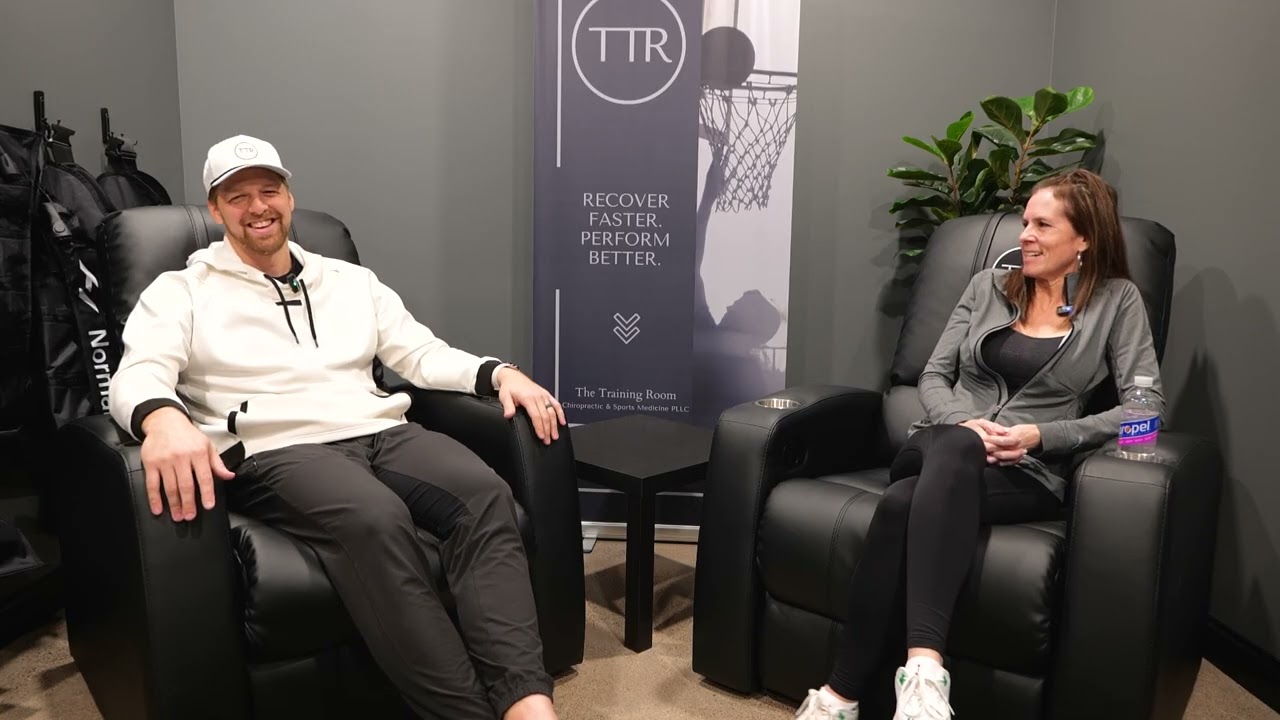
Hey everyone, it's Karissa from Shining Light on Minnesota. Super excited. I'm here in Blaine, which is where I live, which is fun. I'm with Peter Maring from The Training Room. Welcome, Peter. Hi. Thank you. Yes. So, let's get started and tell everybody what The Training Room is and how you got started in it. Yeah. So, we've been open just over a year now. Uh, The Training Room chiropractic and sports medicine is kind of a vision that's spawned over the last handful of years of my career. I spent the last four years out in Washington DC working in orthopedic center with a couple of high level sports teams out there. Yep. Uh me and my wife are both from this area though. Decided to pivot and move back to where families at. Yep. Have two young kids and uh open this up with a vision to really um create a different type of health care a little bit more comprehensive, a little bit more collaborative with other professions. Yeah. Yeah. And that's what we've done over the first year. So when you got started and you thought you went you went you know went to Northwestern went to college thought hey I want to get into sports medicine. You played sports yourself obviously played some basketball did some things there. There's a lot of sports injuries. Getting people back into athletics right away. Getting them back onto the field getting them back onto the court. Everything like that is important. How did you know that you wanted to make a difference? Yeah. From from a young age, I wanted to be involved in sports athletics. I knew I was not going to be a professional athlete. Y played basketball, soccer, baseball in high school. Uh one year of soccer and three years of basketball in college. Yep. Um but wanted to be around sports and and I think there's a lot of um when it comes to sports injuries, people don't have the knowledge or the education or the people in their corner to really help them navigate some of those things in a timeefficient manner. Um there's a lack of collaboration between professions sometimes. Yeah. So that's where I really strive to make a difference. A lot of times when people think chiropractic or they think training, they think it has to happen after the injury, not prior or getting them ready for when they want to start playing sports. How does that differ from what you do? Yeah. I think in the world of medicine as a whole, we're a little reactive when it comes to treatment. Yes. something happens then you go get treatment um with dentistry with your car with other stuff. We are a little bit more proactive. Brush our teeth every day. Yeah. Get our checkups, get our oil change, get but people don't view their body or their muscularkeeletal self the same way often times. So often times people come in with an injury because they're trying to return to play. They're trying to play a game, state tournament, whatever it may be. Yeah. And that's where we need to start educating people earlier with the early specialization in sport that is happening. Um that they need to take care of their bodies all the time. Yes. Well, yep. To minimize the time off the field, off the court um and just perform at a higher level. What are some of the things that you do here? I know you do a lot of chiropractic, but you have hyper ice. You've got some cupping. You've got some other things that you do here. Tell our audience a little bit about everything that you do. Yeah. So, when people are thinking of chiropractic care, they're thinking of primarily the joint manipulation piece of it. Yes. So, that's definitely something that we do. Um, but we work a lot with soft tissue work, pin and stretch, cupping, grasping or scraping, dry needling, a handful of different soft tissue techniques. Um, because people respond differently to different things. Yeah. Uh, different injuries respond differently to different things. Some people have had a really good experience with cupping, for example. Mhm. So then you want to maybe tie that in um to their treatment. So we do that. We have the hyperized stuff, so percussion massage guns and the Normatch air compression boots and sleeves. And then we also utilize a system called Bald, which um there's four stacks. There's digital dynamometry, which is a handheld force plate essentially. But I test almost every patient to actually get some objectivity to what we're doing. Yes. Force output side to side. um asymmetry side to side. So you can catch some nuances of movement patterns of things that people are not maybe moving efficiently, right? So that we can maybe catch injuries or work on stuff prior to an injury. Yes. So when you were in Washington, you had some highlevel athletes that you were dealing with and then you moved to Blaine. Yeah. How how easy or hard was that shift? Uh it was it's quite a shift. It it is a ship. Um, Northern Virginia, Washington DC area is a hustling, bustling Yeah. Uh, high-profile um, high level athletes, doctors, lawyers, politicians, right? CEOs, this kind of stuff. It's It's just a different lifestyle. It doesn't stop. It never shuts off. It correct. Um, you come back to Blaine and it's it's a little bit slower pace. Slower pace. It's a little bit uh it still has that small town Yeah. kind of kind of feel, right? Um people are very loyal to their their high school. They're this, they're that. Right. In DC, everybody is from everywhere. Everywhere. Right. Um working with the football team, they're often times when we're having home games, there's just as many or more fans for every opposing team, right? Um because everybody's from everywhere. Blaine, everybody is local. local. Yeah. Primarily from here. Yep. Centennial, all these different places. People stay in their community and like to be involved in that manner. So, breaking into that is interesting. Getting established, right? People have have known their people for 30 years. They they've gone to the same people forever. Their family, their family. And although me and my wife are from Cambridge originally, so about 40 minutes north of here. um coming back establishing a practice um has has been awesome because when you can break into some of that and people understand what you do, why you do it, how you do it, and how you differ from what else they've experienced, it's really beneficial. It's really making a personal care instead of just saying, "Hey, I'm going to get you and I'm going to do the joint manipulation and send you out on your way." It's really establishing and making your customers feel like they're family, too. Yeah. Yes. No, it re it really is like I I strive to be in the corner of my client. Yeah. Um if they need something to reach out if they have a question, we're collaborating. I'm collaborating with their athletic trainer, potentially their orthopedic surgeon, their spine surgeon, massage therapist, um their personal trainer, whoever it may be. Um so that that person can have really their own little sports medicine team. Yep. that they can take with them and understand their body, understand how to move well and recover well. Do you still see Well, you just got to see some of the football team. Yes. Just a couple weeks ago again. So, how fun was that? It was really fun. Really fun to see my people again. Um thankful and grateful. Uh the medical staff invited me to team dinner. Yes. The the night before, so got to catch up with all those guys and then got some field passes for the day of the game. So hung out with some of the players and other staff that are still around there. Yeah. Uh when I was leaving the team, there's also new coach coming in, new roster, new So there's been a lot of turnover, but there's still a lot of people. Still the same people some that that are still there. Um commanders didn't play that well during that game, right? Unfortunately, um a tough day to wear burgundy, but Right. But you still you still bleed it. You still have it in you. A really really fun weekend. Yeah. Good. What do you think's next? I mean, The Training Room is here. You're starting to get it established. Blaine is growing. Obviously, you don't just have the golf and the sports center. I mean, look at look at everything that Blaine is doing now. You have a baseball field coming and a lot more things coming up. Yeah. Blaine is really becoming a sports hub. Uh the North Metro has not really been a sports hub. No. Um Edina, Egan, Minnetonka, Plymouth, some of these areas for sports medicine. Yep. For complexes, for this kind of stuff. Um Blena's had soccer fields for a while. But now they're really trying to demand attention when it comes to owning that space. Yes. Um not only in the north metro, but the state and the region. So yeah, it's super exciting to see. So you've had the the basketball background, you've had the sports background, you've had all of that stuff, and you have your family, your young family. How do they incorporate into all of this? Yeah, I mean family um and faith are both extremely important to me. Absolutely. Uh, one of the primary reason we moved back to Minnesota, I loved what I was doing in DC. That was a dream job working in orthopedics professional teams. Um, but was to be around family. Yeah. Uh, I'm one of seven kids. Yep. Number six of seven. Um, my daughter uh that was just born in June is grandkid number 20 for my parents. Yep. So, a large family and everybody's here um primarily in the north metro. Nice. Um, so family is super important. Um my wife helps out with the business as well. Yep. Um so really everything that we do is based off of that. Yep. Family first. Um family first to build a business that um we're proud of that the community is proud of that we can help a lot of people. Um but that can also uh serve our family. Our kids can grow up in it. They're going to work here uh when they can. Absolutely. Right. And and everything like that. Yeah. Who have been some of your mentors along the way that have helped guide you to where you are? Yeah, so one of my main mentors, Dr. David Holmes is his name. He was the one that got me into chiropractic in the first place. I was originally a prehysical therapy. Got it. Undergrad. I was going to go the physical therapy route. I liked more of the soft tissue work. I liked more of the uh exercise-based approach. Yep. And I hadn't seen that personally um with chiropractors. I had been to general chiropractors. you go in, get a manipulation, you leave, that kind of stuff. Um, which definitely has a time and place, but it's not necessarily what I wanted to do as a profession, right? So, physical therapy back or undergrad. Um, I met this doctor, Dr. Dave is the name. Um, junior year of college. Yeah. And he worked with uh some packers, some raiders, some highlevel CEOs, this kind of stuff. Um, and he did primarily like soft tissue work, primarily exercise-based approach. And that was interesting because I had never seen that with the credentials of DC, Doctor of Chiropractic. Y um, treating in that type of manner. So, um, I had also blown out my meniscus sophomore year of college playing basketball and went through, uh, PT. Yep. And, um, I didn't want to get sucked up into a big system, right? Um, so it there's a lot of freedom that comes from owning your own business. You can close when you want to. You can see patients when you want to. Yep. It's less about numbers, numbers, numbers sometimes. Correct. Um, so really junior of college, that's when I decided to pivot into the chiropractic scene. So Dr. Dave, um, great mentor. Uh, another one would be Wally Parish. He was the head of kinesiology at Northwestern in St. Paul. Mh. Um, so he really guided me throughout my undergrad. Um, and then my two my two preceptors that I did my first internships with, um, Scott Moing, um, he works with U of M athletics as well. Yep. Um, great man, really involved in the profession. And then Dr. H, he's the guy out in DC. Yeah. That I spent four years with. What about the when people come in and say, "Hey, my surgeon said not to do chiropractic or my doctor says don't do chiropractic because of the surgeries that I've had. How do you deal with that?" Yeah. Um, it depends on what the doctor knows of chiropractic. Yeah. And what they mean by don't do chiropractic. Often times, uh, they're talking about the joint manipulation piece. um which there's a lot more that we can do besides joint manipulation working in the orthopedic center out in DC um and collaborating with those orthos daily. Yep. When they can actually know what we do, see what we do back and forth that way and have a better understanding of what we do. Yep. That question doesn't come up as much. Right. But often times if it if it does, I'm reaching out to the surgeon asking them what's going on or what they mean or that kind of stuff. Yeah. Um because sometimes it's they they just had a surgery and they don't want that manipulation or they've had clients or their own experience that hasn't been positive in the past, right? Um but really that collaboration piece, reaching out to them, communicating and then educating the the patient on on what we do, what their surgeon meant. Y and go from there. Perfect. for what would be safe and effective for the treatment. Yep. What would be one thing that you could tell our guests that are listening or that you could help educate them on when or if they were looking to come into The Training Room? Yeah. Um, a a big thing that people um are maybe unaware of is that you need to find people that know what they're doing, that have your best interest in mind, y are willing to collaborate, but it's really um you need to find a team of providers that is partnering with you. Y and and the the communication should be back and forth between the doctor and the client as well. Yep. There's a lot of um people that will blindly trust information that is given them to them. Um w without maybe further investigation. Yep. Because Dr. Google is always right. Right. Correct. Yes. What they read is always always accurate and what they see. Yes. Yeah. What do you think is you know if you've looked and you've done a lot of studying um people take a lot of advice from a lot of different people. What's some good advice that you've had in the past that you think would be would be good for our viewers? Yeah, in the world of AI and Google like you mentioned and everybody's an expert and Instagram experts and um it can be tough to weed through it, right? I think what's super important is to not over complicate the situation. Make it simple. Um there's a lot there's a lot of like people will get hyped with an injury. um then they'll get really down if they're not getting better. Then they start to see improvement and so it's this whole roller coaster um emotionally with treatment with how their body feels. Um so just trying to stay as even keeled throughout the process. Understand that uh fixing your body can be a little bit of a journey. Yep. And that really consistency over time with movement, with rehab, with anything that you're doing is going to be the most beneficial. That's where you're going to see the results, right? Yep. A lot of times people think, "Hey, I'm going to go in and it's going to be fixed immediately." Yes. And it's not going to be done the next day. It's not going to be just a quick cupping or a quick pop and I'm going to be done and back on the field and ready. Yeah. So, educating people in that manner is super important. We live in a instant gratification culture. Um, but when you're working with higher level athletes too, you do need to be good at what you do. Yes. And get people well in an efficient manner, right? With them understanding uh when to take time off, when to push, you know, when you need to actually rest this injury versus if you're going to play on Sunday either way and we have to nurse this thing throughout the week and you're playing. Yep. Get them home enough to play. At least we need we need to know that. So, like I said, the communication client to doctor, back and forth. What are your goals? What are you going to do? Are you going to play anyway? If you're going to play in the state tournament game, whether I tell you not to or, you know, I need to know that information so we can do everything we possibly can to get somebody out there in a safe manner. Yes. Yep. How many people in the community are you working with currently, and how many more clients are you looking to take on? Yeah, so I'm I'm um I'm probably about 50% capacity wise. Um we really strive to get people well the knowledge and tools and exercises to pro regress and progress exercise depending on how they're feeling. So they have the tools in their own toolbox. Yep. To take care of themselves. So what it looks like to be a patient here is a little bit more like we're going to educate you and hold your hand for a little bit of time and then kind of be on your own and we're here as needed. So, um it's not really a model where people are here long long term. I'm going to nurse you for the rest of your life thing. Yeah. Um depending on their goals and what they're doing, but um yeah, we're we're we're obviously looking to grow, bring a couple more doctors in eventually. Yep. As we continue to go. But, um the first year has been absolutely fantastic. How do you think that the shift in the health and wellness industry has gone? I mean, obviously people are getting smarter and they're getting healthier and they're trying new things and doing new things at home and for themselves. What do you think is going to happen in the future? Yeah, I think it's um I think the collaborative approach is going to be huge. I think some of the fads continue to come and go as well. Yeah. Um things are trendy, some stuff will stick, some stuff will go. The research will get better. But with an instant gratification culture too, people are going to demand results in a quick amount of time. So I think the future of healthcare is going to continue to look like a lot of different doctors and people with different credentials working together. Um coming in when it's their time, doing really what doing what they do well. Yep. Staying in their lane. And if it starts to bleed us out of your lane, get them to the next expert quickly. that can then take over the case law. Thanks. What is one of your favorite quotes? Tough question, huh? Yeah. I It's It's simple. Um, one that stands out to me is just be great. I I think I don't think a lot of people they'll take a quote like that and they'll just kind of move on or not really think about it or what it means. Um, but I don't think enough people are necessarily striving to be great, um, exceptional, masterful at their craft. Um, a lot of people want to be comfortable. Yeah. Get by, right? They're okay with the status quo. So, I would say that's one that does stick out with me. Nice. I think when people really emulate that, you can see that in their life, in the way they act, the way they talk, and the and the people they interact with as well. Absolutely. So, how can people find you? Where can they reach out to you? What can they do to really get a hold of you and get in here and get some help? Um, our website is ttrro.com. Uh, if you go on to there, you can book an appointment right from there, which is easy. Shows my availability. Um, something that's super helpful is to book a discovery visit. So, that's where you can come in free of charge. We talk about what's going on, how we might help that case a little bit. So, you have a really good understanding if we're a good fit for you, if you're a good fit for us. Yep. Because I think it needs to be both ways. Absolutely. Um, I think some businesses just want the want the bodies, want the people, want the Right. Um, but I for for us at The Training Room, we're really focused on if we're a good fit for you, if you're a good fit for us. Yeah. Because it has to go both ways. Um, so TTR Cairo um is where we're at. We're located in Blaine just north of Hole two on Victory Links in the medical office building here. Um, you can call our office, email us or or set up a time to book. What about teams? If teams are looking to have you out? Yeah. So, we we do work with with teams as well. Um, every team is different from from small level y to pros. Even in the NFL, for an example, um, every team might use their chiropractor differently. Correct. The the the time at the facilities, how frequent, do you travel, do you not travel? Yes. Um, so we do work with teams. It depends on really what the team is looking for, what they need. Do you need me to come to your facility once a week? Yep. Look at some people and then if we need more extensive work, maybe you come into the office. Yep. Or or are you looking to have a place to send your athletes? Yes. Um if they need some performance enhancement, if they need a tuneup, if they need some injury care. Yep. Um so it can go a lot of different ways depending on what the team or organization is looking for. And you've worked with all different levels from NFL, NHL, MLE, every level, high school, professional, everything. Yes. College, D1, D2, D3, Olympics, um, every level down to six years old, you know, little Johnny that's out there playing soccer and grandmas and grandpas, everything. Grandmas and grandpas, uh, 95, 96 years old. Yep. So, we work with everybody. We strive to educate and for people to understand their body, their movement, what they need and when. Y and to just really keep people moving and active for as long as possible. Perfect. Well, we appreciate having you on today. I know I've done an assessment. It is phenomenal. It helps me with my golf game. It helps me with my weight training, everything like that. I would just expect everybody to come and at least get an assessment done, find out a little bit more about themselves or just have that conversation, get in here today, come out to Blaine, talk to Dr. Peter. Thank you guys so much for coming on seeing the podcast today. Thank you, Peter, for being our guest. Thank you. Thanks for having me.