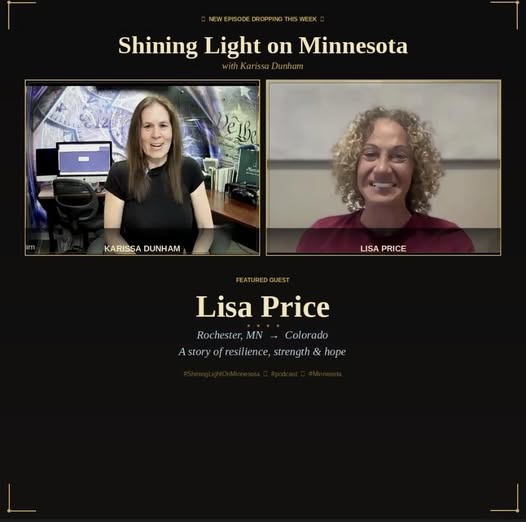
Hi everyone, I'm Karissa from Shining Light on Minnesota. I have one of my dearest friends who I've known since I've been probably first grade, second grade, Lisa Price with me from Rochester, Minnesota. Welcome, Lisa. Hi, thank you so much for having me, Karissa. It's so great to see you after all these years. Yes, it's been so long, but let's go from basketball to softball to everything, but let's tell everybody you just had oral surgery. So, let's tell our viewers a little bit about that from the swollenness to the teeth missing. I've gone through that. I know it's it's horrendous. It's it's painful. It's embarrassing. It's all the things. I know, yes. Yes. So, yes, I just had oral surgery on Thursday. So, I'm still recovering. Face is a little swollen, missing some teeth. Yep. Not the most attractive, but you know what? It is what it is. It's getting older. Yep. And it's it's getting better and it's at least you're doing it. Yes, getting through it. Exactly. Yes. So, we have you on today because I've heard your story multiple times. I've lived with you. I've been through it. I I know it. And you are an amazing person and you are in a such an amazing place today. So, I want to let everybody hear your story. Maybe they can take parts from it, take little nuggets from it, and let's kind of go back to the beginning where it started. I mean, you're from Rochester, I'm from Rochester, and let's share that story a little bit with our viewers. All right, perfect. Well, oh, the story, where it all started. Started in where I am today. Very different places. So, as you know, I grew up in Rochester, Minnesota. Um really into athletics. Was a big basketball player, loved playing softball, baseball. Um never did soccer. No. the one thing I missed. Which it was kind of bigger in Rochester back in those days. Yeah, right? I don't know. I didn't either. So, yeah. Hmm. We we were we were more of like the basketball We were more of had the we had the all the all the other soft softball, basketball, yeah. Baseball, whatever, football, whatever our brothers were doing, we were doing, I guess. Probably, right? was the thing. And we were following what our brothers were doing. Our brothers didn't play soccer, so we didn't play soccer. Yep. We were an extension of them, just following their footsteps, yeah. Exactly. Um but yeah, grew up in Rochester, Minnesota. Um three older brothers, youngest. Um we went to St. John's and went to Lourdes and then we actually all in my family went on to University of St. Thomas. Yep. Not planned, it just kind of happened that way. Um but you know, when I was a young girl, um I really struggled with myself image and liking myself. And I don't know why. I mean, I had fantastic family. I had I had everything, you know, but it was just me. It was There was something in me that I just didn't like myself that much. And I Maybe it was the differences. I had really curly hair. Um and kids are kind of mean. You know, people used to You know, make comments, like remember the troll dolls? Oh, yeah. Yep. Oh, yeah. People would make comments, be like I looked like a troll doll, or you know, you stick your hand in a Did she stick her hand in an electric socket and like her hair go all like that? So, and I was a sensitive kid. you had the curly hair, I had the straight hair. I wanted the curly hair, where you wanted the straight hair. So, it was like back and forth, yeah. [laughter] Right? You always want what you can't have. Right. Absolutely. Um But so, um in being the youngest with three older brothers, and we were a very um How do I say the word? The family My family's fantastic. are amazing. Yeah. The dynamics is fantastic, and I really got noticed by my performances. I um Out of all the kids, I kind of pat myself on the back, cuz I was the only girl, but I was the athlete of the family. Yeah. If Jeff hears this, he might get a little sassy, be like, Yeah, no, but you Yeah, you were. Yeah. Jeff was a great athlete, too, but yes. Yeah. [laughter] Yeah. And so, I got a lot of recognition for that, which I loved because I like attention. Yeah. [laughter] Um and it and it started out as basketball and um loved basketball. It was my I mean, if I could have been a WNBA player, give me like I just needed like 4 or 5 in. They They didn't really have that as much when we were younger, though, to really look up to. It was like the Michael Jordans, the Larry Birds, Charles Barkley. Yeah. God, right? Right. Loved them. Loved I mean, my wall my If you went into my room, it was like posters of all of them. On my ceiling, on my walls. It wasn't like the actors, it was all the basketball players. Well, there was it was like Jordan. Yeah, right. [laughter] Right? Uh Uh Well, unfortunately, my height didn't help me very much in the basketball career. And what happened for me is I also started running when I was in junior high and had a little bit of success for it. And then in high school, um I wasn't going to go out for cross country. I was actually going out for volleyball and I got cut from the volleyball team. And so, lo and behold, decided to do cross country. Yeah. And went out for cross country, loved it. Great. Myron Glass was the coach. Yep, he was basketball and cross country, both. So, they kind of correlated. Yep. Exactly. And I started off and I got really good success. I was good. I was really good. were good. Um and in doing that, though, you know, doing basketball compared to running, it's a lot different on the body. Uh-huh. And so, my body physique really drastically changed. And I got a lot of attention for it and I loved it because I was very insecure about my body early on. And all of a sudden, I'm like, "Oh my gosh, I'm kind of getting the body that I always wanted. I wanted this runner's physique." Um and lo and behold, uh I took it a little too extreme. I, you know, really was not kind to myself looking back. I restricted quite heavily and it just took on it became something that I didn't even know. Yeah. I I I didn't have control over it. I thought I had control over it, but I didn't. And so, um having the loving and great parents that I did, they put me into treatment immediately. Well, they they got me outpatient care right away to get a look on this, but you know, I'm this 15-year-old kid and I have doctors coming to me and stuff and I'm kind of like, "What, you know, I I just didn't know what I didn't know." Right. And so, I I just wanted to run. Right. All as I wanted to do was run. And so, they told me as long as I didn't drop before below a certain weight, I was allowed to run. And I kept it Did you have a dream of wanting to go to the Olympics? Did you think that you were going to like proceed and watch it? to be in a Yeah. I wanted to be an Olympian. I was like, "Basketball isn't going to get me there, so I'm going to be an Olympian." And I was I mean, I I don't want to act like this big head, but no, I was good. Yeah, I know you were. Yeah. Um and uh I was good until I wasn't. And my junior year, things got a little bit too much. And I just I I couldn't even I couldn't get my school work done. My anxiety was so bad. And so, what my parents decided to do is I ended up leaving school for a little bit and I went into treatment. Yeah. And a junior leaving school, kids don't know what they don't know. There's a lot of rumors going around. Some were kind, some Some really mean because people just don't know. They just one day I was there and one day I wasn't there. Right. And while I was in treatment, um this was my junior year, another top runner, um we were in the A and the double A, another top runner in the double A actually entered in the right same time I did. And so, here we are the two top runners, the double A and the A, are all of a sudden gone from competition. Yep. No one knows Oh, the coaches know, but no one else knows. And so, the papers came to us. And the Pioneer Um what was it? Pioneer Express, yeah. They came and they asked to do a story on her, and then the Post Bulletin um must have somehow gotten word where I was, and they did a story on me. Mhm. And again, not knowing what you know, Right, [laughter] yeah. they they had this story, and the story was released the day I got out of treatment, which was also the day of the sectional invite. Yikes. And it's this full-page paper, our full-page story, um front page, Ugh. and I didn't know it, and I'll never forget standing there, um cheering people on, and people coming up to me, just random people just coming up to me, saying all these things, and I'm like, "Huh? And like, "What are you doing?" What am I missing here? Yeah. What am I missing? And then I found out, "Oh, the story was released." And then, you know, you'd think, "Oh, it's this, you know, you're in the paper, that's so great. Oh, she's getting treatment for an eating disorder, that's so great, Mary and Jerry Price. We're so sorry to hear this about your daughter, but it sounds like she's on the mend, and everything's going well." Chrissa, it wasn't. No. I went into treatment as a 16-year-old not even knowing anything. At that time, I I was a 16-year-old kid. Yeah, not ready to make changes, just doing what you're doing. Yeah, [clears throat] just doing what I'm doing, and I come out of treatment still just as confused as I have ever been. I'm not any better. I am I am not any better. In fact, I'm even worse. I went into treatment um anorexic, and I came out of treatment bulimic. But all these people are around me, and I'm a people pleaser, and everyone's like, "Oh, we hope you're getting better. You're hope you're getting better." And so That's making it worse, right? Yeah, I'm I'm faking it. So, I want to tell people what they want to hear. Oh, yeah, thanks for the congrats, where inside I'm beating myself up, like you know, because I don't see myself the way other people's do. I have a distorted body image. And so, it was just that was a very I'm realizing now what a pivotal part of my life that was, because that's where a ton of lies and distrust started. Because this happened my junior year, and then I go into my senior year, and this follows you, because we're in a small town. Oh, very small. so and I go to Lourdes High School, which is a very small high school, and I have to leave every single day for nutrition appointments, therapy appointments, doctors appointments, because my parents are doing what you should be doing, tracking a person with an eating disorder, and I'm keeping the red line. So, you know, I'm I'm I'm you know, I'm not in it, and I am bulimic, so my blood levels are not good. And You learn how to work the system pretty quick, too. And I learned how to work the system. Um so, that was my high school. And and I make it sound bleak and terrible, but there's so many wonderful things about high school, too. Right. But just for like those girls out there that have and boys, I don't want to discriminate. The teenagers out there, I just didn't like myself. Right. I did not like myself in the lying that I was doing just made me not like myself even more, because here my dad was all about honesty. My dad preached honesty. Just be honest. Just be honest. And my dad is a recovering alcoholic. He's been sober now for 40 years. Yep, amazing. I know, yes. I I remember from way back in the day, yes. That was so amazing, yes. And he was very he was active in the AA community. I mean, he always went to his meetings. And so, you know, he really believed in the 12 steps, and he believed in honesty, and he would hit that with me. And I wanted to be the people pleaser, and I loved I idolized my dad. And so, I never, you know, I didn't want to lie, but yet when you're in an addiction, which an eating disorder is kind of an addiction. All it is is a cycle. All I was doing was lying. I was lying about how much I would exercise eat. I was lying about how much I was eating. Um and it just And in doing the things that are against your morals, you just kind of beat yourself up. Yep. Lo and behold, went on to college. Yep. Loved college. College was a blast. Went to University of St. Thomas. And for me, the eating disorder I still had, but it morphed more into drinking at that time. But at drinking at that time I'm in college, that's what every kid does. But it numbs it numbs the pain, too. It numb It Drinking was my solution. All of a sudden, I took these drinks, and I As soon as that alcohol hit me, I I got this self-confidence that just was like, "Wow, I love the way I look." And got this confidence, and was you know, this false confidence, but the confidence that I wanted so badly Yep. that drinking gave me. And then when I drank, I did things I wasn't proud of. I was a little promiscuous. I made some stupid decisions, which again then the self-hate. You know, it's against my morals, and I can't be honest about the stuff. I or I didn't feel comfortable being honest about the stuff because I felt so bad about what I was doing, and it just kind of went down into the self-hate. Right. Um you know, went through college though. I had a fantastic college experience. My daughter is going to be a freshman next year. She's going to San Diego State. that's amazing. Yes. I know. I'm so excited for her. Everybody has to live a college experience to get away, to do their thing, figure out who they are cuz that's what leads you to really who you are. Like getting away and doing the things and making food on your own and learning how to live with other people and just doing all those things. Yes. For her it's going to be waking up on her own. Yeah. [laughter] Not having mom wake you up like Making like I mean even just the figuring out the food and getting the classes on time and just all that stuff. Yeah. Yeah. Yeah. Yeah. So went on to college, had a fantastic college experience but still had the demons in me. But I was masked I was a very high functioning [clears throat] person with an eating disorder and a very at that time I wouldn't say alcoholic. I would say I was just a college kid. While I was in college though, I still was getting treatment for the eating disorder. You know, eating disorders I just learned I was listening to a podcast this weekend and only 6% of people with an eating disorder are underweight. Mhm. Yeah. Only 6%. That's crazy. That blew my mind. That is crazy. of people with an eating disorder you would have no idea looking at people if they have you have no idea what they're struggling with. Right. Um it's it was it it the it really baffled me. It really just made me see you can't judge a book by its cover. Right. So I was really struggling with the eating disorder try very high functioning but working out a lot and the amount that I was working out achieving what I was trying to achieve I just I couldn't do it. My body would break and so I went into treatment several different times in my early 20s. Yeah. Um I had some really great experiences and I had some really low experiences and then I would say in 2009 things really changed for me. I had had a daughter in 2008. um In 2009 that summer I was married and I kind of hit a really low spot in my life. And I went again into treatment for alcohol at this time. We did not address the eating disorder. [clears throat] The eating disorder just ran rampant. I mean, I will never I was that girl in treatment and I had them convinced that I was allowed to run loops around the year. I mean, it was crazy Chris a lot back at it. But I got sober right and I found the 12 steps and it was so healing. It was so healing. I was able all of these deep dark secrets that I had about myself, these resentments I had about other people. I got them off my chest which and healing that I got from it. It's like I I started to like myself again. And it was really cool how my life was starting to go off. It was it was I was married. I had started a business with my sister-in-law. I had this beautiful daughter. We were living in Rochester. Life was going really well. You know, I had some hiccups earlier in my 20s, but you know, things are going on. Until they weren't and like that's the one thing that I want to say to everyone. You have to continue doing work. And what I did is I kind of got complacent. I stopped doing the work on myself and what happened to me is in 2013 I relapsed. And when I relapsed um it was a very very again secretive. Didn't want anyone to know and it just became something that happened one time turned into a bigger thing. Um and what happened was it led to is um my husband and I at that time decided to move to Colorado. We had lived in Rochester. Uh, I was born and raised in Rochester. He lived in South St. Paul. We're like Minnesota winters were over it. Let's go to Colorado. And you know, in my head I'm thinking overbearing family. We're going to go do a geographical change. I'm not doing that. Well, maybe this is new environment. Everything's going to magically fix itself. Remake myself. Let's just do this. Yeah. Exactly. So, came out to Colorado. Um, and just downfall. I I just now having no accountability, no one here. My drinking took off. The eating disorder took off. And before you know it, my marriage ended. Um, so now I'm a single mom. Uh, you know, again trying to keep up with the Joneses, have a good look at like, you know, everybody on the outside. I don't want them to worry. I have this great front going on. But behind the scenes, it's pretty damaging. Right. Not a lot of good stuff is going on here. Yeah. And um, making just making doing things that are not the best things to be doing. And again, Yeah. what happened is a lot of self-hate. And it just continued to come on top on top on top. And the only way I knew how to feel better was to exercise. And then I'm exercising so much. And I'm out here in Colorado. And Colorado is where elite athletes go, right? Right. Oh, for sure. Oh, now my dream of being an Olympian, we're going to make this a reality. Yeah. So, when I moved out to Colorado, I joined an elite training group. Yeah. Oh, boy. Here we go. Yeah. Didn't tell the coach my history. Brad Hudson was the coach. He somehow believed enough in me, or I was somehow manipulated him enough to believe I was going to be the up and next coming thing that he allowed me to group join his group of athletes, which let me say right now, I was at the bottom. I mean, these these I mean, he had Olympians. I mean, these women are amazing. Yeah. He amazing athletes, but I I came into the group um and now I'm thinking to myself, my dream's coming true. I can now become an Olympic athlete. Well, the problem is I still don't have the eating disorder under control and I'm still drinking a crap ton. So, how am I going to perform doing these things? So, doing the best I can, which isn't very good, and [clears throat] not feeling my body the way it should be, and overtraining, you know, I'm getting injured. I can't [clears throat] I can't keep up with what he wants me to do. And so, I hurt myself. Break my I'm I'm I'm constantly dealing with one injury after another injury after another injury, and then again, the self-hate. So, now I can't exercise the way I want to exercise and Chris, it was a nightmare. It It It was It was not a fun place to be in and no one wants to be in that place. You know, so I'm I'm trying to hold on to what are things about myself that I like about myself. You know, I So, now I I move into I meet this man. Sweeps me off my feet. I've always loved kids, loved family. He has two boys and I'm thinking, oh my god, this is it. This is perfect. Bridget can now have brothers. I can have the family. Everything's fantastic. So, we get married and now I'm going to become the mom. Yeah, I've got all the things now. I've got the I've got everything. Now, I've got it. I'm your Joneses now. Everybody can keep up with me. Yep. Exactly. And my husband, he was very attractive. The boys were great looking. My daughter, I mean, picture perfect people looking on the outside. I mean, we were the great family, but no one really knew what was going on on the inside. Um and you know, I I did the best I could with where I was at. I um Looking back at that now, you know, I always wanted to be a role model to my daughter. Yeah. And what was sad is what I would say to my daughter is don't do what mommy's doing. Right. What mom I was always would tell people I'm like I'm very upfront with my daughter. She knows everything that's going on. Yeah, I'm telling her don't do what mommy does. I mean that's terrible. I'm not I'm not being a role model. I'm being terrible. Because your dad would always tell you you're beautiful. I mean he would instill that in you and all of us when we were younger too. Like you guys are gorgeous, you're beautiful. Like keeping being smart, doing good things, making good choices, all the things, you know. Yeah. Yeah. Yes. And um you know, I I I had to take a big look at myself in the mirror and I realized wow, I am not living the way I want to live. And so life goes on. So, you know, take back let's say this is back now in 2016 and I'm married and on the outside again everything looks great, but internally I'm really really struggling. Yeah. Um and being a complete not telling anybody what's really truly going on. I am lying to everyone. I'm lying to I I'm seeing a therapist. I'm not even being honest to this therapist. I'm telling her what she wants to hear. Yeah. Um and it got to the point where I just couldn't keep doing it anymore and I didn't know what else to do. And unfortunately um I became suicidal. Oh. You know, there were uh couple times that I I tried to not be here anymore and it Yeah. I I hate that I did that. Yeah. But I did that. Um you know, obviously thankfully it didn't happen. Right. Um but it just shows how low of a place I was at. Right. I was very very low and I think there's a lot of people out there that can relate to this and they just don't say it. Um and it's it's not okay to be in that place. And when you're in that place trying to get out of that place seems impossible. Yeah. Um, I know it did for me. I what kept me going during that time was my daughter. Right. 100% my daughter and just kept thinking, "Wait a second. I can't do this." I'm like the you know, they say when somebody is in that low, they don't know what else to do. And so my heart goes out for those people. Yet at the same sense, the family and the loved ones, oh my god, the pain that it puts on those people as well. It's just it's terrible for everyone. They're going to have to live with your choices is kind of the thought process, yeah. Right. And for whatever reason, I was able to hang on to my daughter and not wanting her, I'm like, "God, she can't She can't go through high school, you know, graduation and not have a mom." I don't want her to have her And I was thinking in my head, "Okay, I'll get her through like this is where my head was thinking. I'll get her through high school and then I can do it. Well, then I'm like, "No, she's going to need me in college." And then, "No, she's going to need me when she gets married." And then, "No, she's going to need me if she has So it's like I kept progressing and then progressing being like, "I can't do it. I can't do it." Well, it's just thank goodness. and so then I I knew I needed help. Yep. And so this was in the fall of 2024. 2024, um, I'm 44, 45. I'm Help me with ages here. And um, you know, pre-menopause. Yep. And I'm I'm thinking I'm just crazy. Right. Yeah. [laughter] I'm just That's Cuz you left your you left your husband and his two boys. So then it was just you and Bridget when you were going through that, correct? Well, so I had left my husband and those two boys back in 2022. So when Bridget was uh, going into her freshman year of high school, I I moved out. Okay. Um and we were going to get divorced. And um it didn't happen. Uh we ended up rekindling, and I moved back into the house uh end of her freshman year going into her sophomore year. So, now at this time I'm still in the house. So, this is now Bridget's junior year. So, the fall of Bridget's junior year, and I'm in the house. it. And not in a good marriage. Uh you know, at this point I'm drinking. And when I in my later time in life, like um after 2009 when I got sober, and then in 2013 when I relapsed, um in 2016 I got sober again for a couple of years, and then I relapsed again in 2018. And those relapses from 2018 until 2025, early 2025, it wasn't like an everyday type drinking. Right. It was like once every 6 months. Sporadic. yeah. I'd go 9 months. And then I'd go 3 months. But the problem is when I would drink, um my husband at the time really threw it in my face. Um so, instead of it being, "God, I'm really sorry that you you what what let's go get you some help." Instead it was like, "We got to call Bridget. Did you know your mom just relapsed? We got to call your dad." I mean, we made it a bigger production than what it was. And I don't want to put words into his mouth because for him I can imagine it was very frustrating. Um so, it just wasn't handled very well. But what it did for me was it just created so much more self-hate. Yeah. Um and so, in 2024, um I'm thinking now, maybe it's menopause. I'm perimenopause. Yes, for sure. Everybody talks about when me you you go through that stuff, your hormones are all over the crazy. I I know the answer why I'm crazy. I just need my hormones. Yep. Let's do some hormone replacement then. Let's do something, yeah. [laughter] Exactly. So, went to my family doctor and she put me on hormones. Mhm. And this was in the fall and thinking, "Okay, everything's going to be okay." It I think it helped a little bit, but it didn't It didn't. And so, now I'm going back and it's the end It's um December of 2024 and I'm like, "Listen, I'm I'm not getting any better." No. And I'm like, "Maybe I've been on these SSRs for so long, maybe we need to replace them or take a look at them." She's like, "That's a great idea. Let's get you set up with a psychiatrist." So, I made an appointment with a psychiatrist and had my meds looked at. Yep. And I went to this place and I'm going to plug them because I owe so much of my recovery to them. Yep. Um I went to Serenity Mental Health Systems. Um I went to their location in Superior, Colorado. Yep. And I walked in and I met with a psychiatrist and the first thing I noticed in meeting with a psychiatrist was it was a person that just looked like he looked like he was like I was going to meet him with a friend. Yeah. And I was like kind of taken aback because my history and my experience with psychiatrist is, you know, they were It's Mayo Clinic, yeah, right. Yeah, like almost untouchable. Mhm. Like like they were so I'm so beneath them. Right. Is honestly how I felt and now I'm meeting with a psychiatrist that I'm on the same level with. Right. And or I felt like I shouldn't say that. I felt like I was on the same level with. Yeah. And she sits me down in her office and we go through my history and my meds. Um and then she's like, "Have you just thought of alternative methods?" And I'm like, "I don't know what she's talking about. Like alternative methods, huh?" And then at that time she explained to me this thing called TMS. Mhm. Um and TMS and I'm not a doctor. Right. So, I'm going to get a lot of this stuff wrong. But explain it in your own words and that's what people need to know, yeah. Exactly. For me explaining it, TMS is is this trans um trans-cranial therapy through the neurons in your brain. Mhm. And so I went and what she said to the me is it's like a 38-day It's a 38 time and it might not even be 38 days. It could be 35 or 30 Somewhere in there, but it's 38 times you go five days a week and they're 20-minute sessions. Mhm. And when you go in you have a technician that meets with you. Yeah. Um what they do is they put a cap over your head. Mhm. Um and the cap uh they they put the cap over your head and then after they put the cap over your head it's almost like you're going into a dryer at those hair salons. it. Yeah. So then another thing comes over your head and it's like a tapping. Mhm. So it's almost like a a woodpecker and it it's a tapping and from my understanding it's it's changing the neurons in your brain. And so it's kind of changing the way you think. And so she was telling me um the studies have shown fantastic help with people with PTSD, people with trauma, people with severe depression, even women going through menopause. I mean she just had all these fantastic things to tell me about. So I'm like, why not? Let's just try it. It's alternative. Let's do it. Yeah. Alternative and did it. So uh we did it. Um I was lucky that my insurance, not all insurance companies and it is it is a bit of a cost and I was I was lucky that my insurance covered it at the time. Knowing what I know now, if my insurance didn't cover it, I would 100% do it again. It's so worth it. But so we started with these sessions and I'd go in every day for 20 minutes. And it's just like a commitment, too. I mean I mean cuz now I'm driving from my house to the I mean it's a it's about an hour and 15-minute commitment of me to do every single day. Yeah. Um but I commit to it. And I start going and within about 2 weeks, I kind of start noticing a change. And the changes are subtle. And what the changes are, I'm naturally a very high-energy, positive person. Yeah. Um, and I fake it really well. And I can tell when I'm faking it and when I'm not faking it. And I to keep up the front, I was always faking it. And all of a sudden, I realized, "Oh, I'm not really faking it that much anymore. It's not that hard. And getting out of bed is a little easier." Huh. And so, within 2 weeks, I'm kind of noticing this difference. And you know, I'm more up It's like I'm kind of feeling like myself again. And it feels really good. So, when you Um, when you were like going through all your things, you used to like to sleep? Did you sleep a lot like when you're going through everything? I Chrissa, that I I I when I moved back So, as I had said, I I moved out um, from my husband when my daughter was a freshman. Mhm. Um, I believe it was 2022, her freshman year. And when I moved back into the house, I think it was 2023, that summer, that's when the sleep got really bad. Got it. Um, and I just I didn't know how to survive. And so, my coping, how I knew how to cope was to shut it off. Yep. I shut everything off, which was for me was to go to sleep. Yep. So, here I had come back into this relationship that I didn't want to be in, but I didn't know how not to be in it. Right. Um, and so, yeah, I slept. I mean, I I was either sleeping or exercising. Yep. Or, you know, trying to be this this show this this fake person to people that were coming over. Which is exhausting in itself. Yeah. And I And I couldn't not get out of bed. Like, I just I just couldn't. I remember like, Bridget would go to school and I'd be like, "God, I got to start working. I got to start working." I'm like, "Oh, I'm just going to go lay down for 10 or 15 minutes." And that 10 or 15 minutes turns into a couple of hours. Yeah. So, fast forward, I lost my job. Right. They they I I got fired from my job because I wasn't performing. I mean, they didn't know I was sleepy and I wasn't telling them what was truly going on. They Yeah, they looked at me from a performance stand standpoint. They're like, "You're not hitting your numbers." And I was always a top performer. I mean, Yeah. Well, right. Of course. I always Well, cuz when you do everything at 150% it's just like you go and you do it and you fake it and you just keep going. Yeah, you're crushing it. Yeah. Yeah. Yes. And so, all of the sudden like things were really starting to hit. Yeah. Like I was really starting to see the effects of my mental health. Um it just it wasn't good. Um When you moved out, did you move back home or where did you move when you moved out? So, when I moved out from uh my ex the first time we moved into a town home. Got it. Yeah. Um and and I will say that that year was pretty fantastic. Yeah. I was doing It was fantastic until I went back. Right. Um and then went back into the house and then it was uh the the What it was 2024. So, it was now 2025 Yeah, since Oh my god, this is I mean just happened. Yeah. So, it's now 20 January of 2025. I'm doing the TMS. Yeah. Um and all of a sudden I'm starting to like myself a little bit. And I had a friend living with me. Um All right. I took a friend in who because I'm I want to help everyone, Crissa. You don't even want to know how many people I have taken in. Right. [laughter] It's like, "This worked for me. Let's just keep it going." Yeah. I'm like I'm like I'm not going to look at myself. I'm going to fix everyone else and I can just stay, you know, I'm really good at fixing people. Not good at fixing myself, but so. Had a friend living with me, um you know, having all the attention on her, not having to look at myself, not looking up and see I'm doing the TMS treatment, getting my head right. Um you know, but I'm still at this time I'm really deep in with the eating disorder and I'm in total denial. Right. Total denial. I mean, I am working out I mean, there were periods of Oh, I Yeah, I mean, from I mean, it's a I don't even want to say the number because it's so I mean, I was running over 200 miles a week Mhm. for 10 15 20 years. I mean, it was the amount of stress I was putting on my body Yeah. and I normalized it and I normalized it to my kids. Yeah. is pretty terrible. Um but so she's living with me in January. I'm going through these TMS treatments and a change is coming in me and I'm starting to like myself again. And I'm starting to realize I'm in an environment where I'm not being treated very well and I knew this before. Yeah. It's not like it all of a sudden came. I've always known this. I just didn't have a voice. Right. And now all of a sudden I'm getting a voice and I'm realizing I need to make a change and it's just amazing how the uniform universe works. So, I have my friend living with me. We get her into treatment. Um she goes to an acute place here in Denver for eating disorders. It's almost like an intensive care unit. Yeah. But she went into this unit to stabilize her in health so she could be okay to go to an inpatient place later on. Um so she stabilizes and it's March 4th, 2025 and she's ready to go on to an inpatient place, which is in Arizona. Amazing. Um and she needs she can't travel alone. So, of course I I volunteered to go with her and we're going to Wickenburg, Arizona to take her to treatment and rewind, when I was 25 years old, I went to Wickenburg, Arizona, as well. were familiar with it. You knew the place, yeah. I knew. I'm like, "Oh, the horses are going to be there." Ooh, yep. I'm going back to the place I know. I went back to the place I know. Yep. [laughter] Um so, take her there, drop her off, and then I decided that, you know, I I spent a day there in Chandler, because after I was in Wickenburg, I did a step-down program there, and I actually lived there for about 6 months. Mhm. And so, I stayed at a hotel right where the The house that I lived in in Chandler is no longer there. They redeveloped that area, but it was still right by that area. And that next morning, I went for a run, and it's like I can't explain it. It was uh So, I had ran those streets over and over, because in 2020, you know, when I was 25, and I lived there, the eating disorder was still strong. Um and so, I was still exercising um back then. But here, fast forward now at March of 20 years later, yep. last year, Yep. um I go on the same run, and I'm, you know, the places have changed a lot, and they haven't, and there was a church. And I used to always run in In Arizona, it's hot. And so, I used to always stop at this church, and I used to always go in and use the bathroom, and get water. And I stopped at this church, and I'm Catholic, and I'm not a I'm a non-practicing Catholic, but I was born and raised Catholic. Um I I have a very strong uh spiritual faith. Um I don't want to get into religions, because Right. We Yeah, that's that's a rabbit hole. That's [laughter] Yep. Exactly. But I I do feel a lot when I go into a church, and I pray. That That really is something that comforts me. And so, for whatever reason, I went into that church, and I prayed. And I came out of that church and I continued running and things just kind of started coming out of me and I'm like God, I remember being here when I was 25 and I was going so great with my health. I had, you know, I was in eating disorder treatment. Yes, I was still exercising but I wasn't purging. I was at a healthy weight. I wasn't drinking. Um you know, recovery from an eating disorder isn't you know, straight. It's It's up It's up and down. I was I was on my road to recovery and my outlook of life back then, I mean, I was going to take over the world. You're crushing it. Yeah. And fresh and I and I was. When I got out when I was 25, I was and then I wasn't and just kind of it gave me a good reflection of where my life is at right then and what I wanted my life to be at and it was not what I wanted and I'm a firm believer is you can make a change if you want to make the change. Yeah, you can. People can change if they're willing to do the work and it finally hit me that I'm ready to do this work. I'm ready to change and and I do want to say throughout these years from from from when I got divorced or my husband I first separated 2014 until 2024 I never gave up hope in myself. There was always this little thing in me that had hope but I just wasn't ready yet. Yeah. I just wasn't I needed what I was doing to survive. I didn't have the tools to survive in another way. So I knew one day I would but it just I just wasn't ready then and for I was ready. I was finally ready. And I left that trip. I came home and that day I told my husband I wanted a divorce and that we're done. Yeah. Um and you can imagine that was just again an up and down type thing. And I moved out of the house a little dramatically in April. That's okay. You know you and you know your your person now though. You've got you've got soul to you. You're like, all right, I'm I'm me now. I can do this. I did and I was in a hotel room. I I cuz I didn't have any place to live. Um and my Bridget's father um and I are fantastic friends and we get along great and he asked me, you know, come stay with me but he's in a two-bedroom apartment. I'm like, no, I can't stay with you. Um so I got a hotel and I lived in a hotel in a week for a week until I was able to find a place for Bridget and I to move to because, you know, she's now I mean I'm uprooting her. It's April of her junior year. Um I'm completely uprooting her. And she's got finals so I need to find a place for her but then I also need to know more importantly what am I going to do? I need to now change and I am now ready to change. And I just threw I wasn't working at the time because I had lost my job that summer. And so thank God thank God the support of my family because there's so many women that don't have that support. And thankfully I had I was able to lean on my family for support. Um and I threw everything I knew into recovery. And the day I walked out of the house was the last day I had a drink. So April 7th, 2025 is my sobriety date. So now it's what April 27th, 2026. So I have a year and 10 days. Yeah and my life started to change for the better and it wasn't easy. It was freaking hard, Crissa. It was so hard. And you know, I got a little worse before I got better and I think that's kind of how eating disorders go. Um Right. I I was finally able to be an honest with myself and honest with my family, and I was like, "I can't do this on my own. I would love to be able to do this on my own, but at this point, I have a lot of weight to restore, and I really need to stop these exercise symptoms." Um So So, I want to do go back. So, in I was heavily bulimic from the age of 17 until 2017. Yeah. And I uh you know, throughout my journey, I I stopped throwing up July 24th of 2017. Got it. And so, when I hit that milestone in my head, I told myself I was cured of the eating disorder. Course. So, even though I wasn't, I told myself I was. So, if people are wondering, well, you know, she's working out like this, but I I I believed I was. Right. That's no longer true. I'm not throwing up anymore. I'm good. I've got this now. Yeah. I've I've got this now. And And And you know, you have everybody outside, you know, they're People love a thin person. Right. You know, my husband at the time That's the culture. That's what they want. Right. Yeah, and my husband at the time really liked thin, and so he just Listen, I had an eating disorder way before I met him, and I would have had an eating disorder without meeting him, but when you're in an environment that's supporting your negative habits, you just keep doing the negative habits, and I was in an environment that was very much supportive of the bad things I was doing. Right. Um And I convinced myself that I was cured. Right. You know, I didn't think exercise was a big deal. I didn't think being low weighted, you know, because society tells us it's okay. Right. Um But so then then fast forward now, so I'm in it's uh 2025, spring of 2025, May, um and I'm realizing that I need more support on doing this. I'm not going to be able to do it on my own. And so that's when I looked into again eating disorder treatment. And let me tell you, Alyssa, I've been in at this time I've been in 12 treatments. Right. I'm 47 years old. I mean, the shame that I have on myself really I'm going to go back again. Number 13. I mean, that was hard. But as hard as it was, I'm so glad I did it. Yep. And if people are out there struggling, just do it. Because even if you're an old lady or an older person going in now, it doesn't they don't care about the age. They don't care about the age. No. These these diseases they don't care who you are. It affects a 15-year-old just as much as it does a 60-year-old. Or an 80-year-old. There's a lot of older people that have it, too. Yeah. And the people that have had I mean, I've had this I've been struggling with this since I was a I don't know life I do not know what life is like without having an eating disorder. I do not know what it's like to be in an at this time I don't know what it's like to be an adult body cuz I never had an adult body. Sure, I I gave birth to Bridget, but I stayed in that for a very little bit of time. Right. So now I have to figure out navigate to this body I'm used to into now what a healthy body looks like. So I I went and got treatment. And I went to a place in Boulder Mhm. called La Luna. And I did an outpatient I did a PHP, so partial hospitalization program. It was advised that I went inpatient, but for me I didn't want to do that because one I didn't want to leave my daughter. And two, I'm really good at treatment. Yeah. I'm really good at treatment. gone through them enough times that you just know how they work. I know I know the system. I go in, I make best friends with everyone. I do what I need to do, and then I get out, and that's it. the system, probably. Yeah. Yes. So I knew I needed to um I I needed to do it a little differently. And I also knew that I couldn't have someone telling me not to work out. Right. And I was very upfront. Exercise had been my problem from the beginning. Right. And so, you go into these treatment places and they're doing what they're supposed to do and cut off cut off activity, which is the right thing to do. But for someone like me, they've always cut off activity. I found other ways to get around it. And so, I was honest with them and I said, "Listen, this is where I'm at. I would love to be here, but I'm not there yet. And I need you to work with me at getting to this place." And when I went in, I never ever thought I would get to be where I am today. Yeah. So, thank you so much for La Luna for working with me. Yeah. Um it was not easy. It was very hard, but they were able to work with me and I was able to slowly progress to where I am today. Right. Um very unconventional, but it worked. And I think for me, what happened was me if I look back at everything, like, what was the thing that changed? What changed? And it was like I started to like myself. Mhm. I really just started to like myself. And that all happened, I think, with the TMS. Yeah. Um and it it you know, I then I stopped drinking. So, now I'm not doing things that I don't dislike. I'm fighting the eating disorders. So, now the role model that I want to be, I'm becoming that role model. Yeah. A big part of it is, too, I'm feeding myself. Yeah. I mean, I didn't realize how much I was starving myself and how malnourished I was. And when you're malnourished, your brain doesn't think Right. for sure. So, getting the food to help my brain think. And then, too, you know, I I was just re-changing the things that I had told myself before. Before I told myself thin thin thin and now I reprogrammed that and it's no longer thin, it's healthy. I want to be a role model. I want to be a healthy Who cares what my body looks like? Who freaking cares? It doesn't matter. I'm in this thing it What matters is me. What matters is how I'm showing up for people. Um And that you are showing up. Yeah. And that I am showing up and throughout the progress um you know, there's ups and downs And there's going to be more of those. A lot of big things. Yes. Bridget going to school and all the weddings and all the things that will yeah. Bridget's going to You're right. I mean, it's like I'm in another transition of my life. It's like I'm glad I'm at I am at where I I'm so happy I am where I am now, but in a couple of months from now it's going to be another transition. to reinvent yourself again like you by yourself like let's do this. Yeah. Yeah. What What I mean, what's the What's this next phase? But I am so grateful that is I did I did a lot of work this last year. I did a lot of work on myself. I invested wholly in myself. I took It wasn't fun. It wasn't pretty, um but I'm on the other side of it and it feels so fantastic to be on that other side. And what I'm finding is I'm just sharing my story with other people. There's so many people out there that struggle and they don't say anything. Right. And it Let's Let's Let's start saying something. to be open. You have to be honest. You have to be honest with yourself first before you can be honest with other people. And even just taking little nuggets from people and like, okay, how did you get to where you are today or how you know, how are people like when you were going through the suicidal stuff? Like how was treatment going through that? Just the little things that people don't understand and see, you know? And And also I don't want to normalize it, but I do want to normalize it. Everybody goes through downs in their lives. Not as maybe not as extreme. Everybody has a story to tell. everybody Everybody has a story to tell and everybody's story is valid. Right. And everybody's story and and you know, you're seen, you're heard. Life is hard. Life is hard, but you know what? As people, as humans, we can get through hard things. Yep. We can we can do hard things and um you know, for me what I had to to learn is you know, with an eating disorder, it's almost like you have two voices. You know, I had the eating disorder voice and I had the healthy Lisa voice. And for me, I really had to put a distinct a name on that eating disorder because it's so believable. It's so And and I still Chris, I still struggle with it. Right. I mean, I it's not like it's gone away. I still have that. sure. And it's always probably going to be there. It always will be there. It's just a lot It's not as loud. Right. You know, it it's not And so I know I can choose the healthier voice, but I know I have to keep going in the right direction. And some days, you know, I I might exercise a little too much. And I have to take a look at myself and okay, so I did that one day. Let's acknowledge it. I did that. Now tomorrow, let's make it better. Yep. What I think the problem would come into where I need to be heavily aware of myself is is that one day, oh, I exercised too much this day. And then [clears throat] I exercised too much this day. Be aware of it. And it keeps building and building and building. That's where then I think you can go back and look at a possible relapse. And that's where I have very healthy people in my life to keep me aligned. Yep. Um you know, and and so that's, you know, road to recovery, it it's it's like this and I'm in the process of doing it. So, eating now, you're able to go out and share meals with Bridget and do all those things too. hot. people a little bit about that and how amazing that is. It's just so It's like I I missed out on life. Yeah. Uh Bridget and I went to Charleston for a mother-daughter and we celebrate our birthday Our birthdays are in January. So over President's weekend, we went to Charleston together. And we love traveling. And you know, ever since she's a little girl, I've traveled everywhere. But you know, food I always loved getting dressed up and you know, we love Fancy things, yeah. Yeah. and you know, going out and stuff. But the food part I never really liked. Right. And now it's just It's so fun. to go on a food trip. Let's do this, yeah. Exactly. [laughter] And it's like just trying the different things and actually enjoying it. And I think the biggest thing is giving myself permission. Mhm. Giving myself permission that who cares? I am on vacation. If I want to have I mean, we go out we order two or three desserts because we're dessert people. Yeah. Yes, of course, right? You've got to try it. You've got to do it because for so long you can't and it's It's all the sweets, yes. Yeah. So I mean, and that's just sharing meals with her and it just it brings a different bonding together and it you know, with her it's like it's showing her so you know, in her younger years, I wasn't the best role model. Mhm. Um and I can't you know, I can't change that. It is what it is. But I can talk about it. We don't We don't We don't have to We can talk about it and then I can say yes, that I was not healthy at that time. I was not being a good role model. But now look at what we're doing. We're making new memories now. We're starting fresh. Let's You know, we went to Charleston and we had those desserts and we split. You had one thing, I had another and we shared it, you know? Let's Yeah. Yeah. Yeah. Let's do that again. Let's try it again. Let's go somewhere new, yeah. Yeah. And And see, and be my biggest thing is her and her friends. I mean, these young women are They have everything in front of them. But the one thing they have holding them back, like all of us do, is our own. It's ourselves. Getting inside our head. It's our It's us getting inside our head. It's It's us So, it's like, you know, trying Now, you know, the best I can do is talk about the things that are in your head. Yeah. You know, that's what I tell my daughter constantly is talk about it. And the things we tell ourselves are the things we're going to believe. Like, for so long, I told myself these mean things. Mhm. I would never say that to anyone. So, why is that okay to say it to myself? But, yet, I said it was okay to I'm guilty you know, I'm stronger than people. I'm this, so I can be mean to myself. Yeah. Being self-conscious. Like, yes, everybody's self-conscious, but you have to live with who you are, too. Yeah. Yep. Yeah. So, it's like, stop looking at yourself in the mirror and stop telling yourself you're stupid and stuff. I mean, I I struggled really bad with learning disabilities when I was younger. Um so, on top of the body issues I had, I also, you know, I was dumb, you know, and you know, and in grade school, you know, St. John's, you know, back in the day. And it's it's still an issue today. I mean, we're we're in the school system that's in this box, right? And as long as you fit in the box, you're fine. But, what about these learners that learn a lot had categories categorized testing. And if you weren't in that category, and you were below it, then you were somebody else, like Yep. Yep. And that's it's just it's such a shame of how what What's sad is we do it today to these young kids. Same goes with school with SATs with everything. Yeah. Yep. Kids learn differently. Just because you might not be good at standardized testing, doesn't mean you're dumb. Yep. You just need a different method. And it's, you know, I I As As the world evolves, as AI comes into play, as different learning methods, I mean, I I hope it gets better for these kids because it's we don't all fit into a a box, you know? And that That mean since you don't fit inside that box, that doesn't mean you're better or worse than anyone else. Do you feel like when you grew up, and this is kind of probably where I'm at, too, having older brothers kind of molded you to where you are today? Following in their footsteps. I mean, I I can say, I mean, I had older brothers that were athletes. And I got burnt out. So, that's why I went into the golf world. Like, it gets to be a lot, and it makes you who you are, and you kind of go through those following in their footsteps, following in their footsteps. You're the youngest, you're the girl. You You do your things. But, yeah, it's one of those It makes you who you are. I can say that. It makes you who you are, and you live and learn, and yes, you kind of want to be your own self. But, you are an athlete, just like I am, and it pushes you to your limits, too. It It pushes you to your limits, [laughter] too. It's It's a tough kind of conundrum, right? It is a conundrum in in in living in the family I live in, um, you know, and and I think with anyone, I got recognition for things I was doing. Yeah. So, I as long as I was a doer, Right. getting recognition. Right. And that kind of built me who I was. So, I will say relearning now at this age, it's like, so who am I without doing? I wanted to make a name for myself. Like, probably like you did, you know? Like, you have a name that you had to follow because you were the youngest and your own person. So, that's why I stopped playing basketball. Because it's a burnout. I I have other people to follow from the basketball name. So, I'm like, okay, I'm going to do something completely my own. I want to go play golf. Like, Yeah. you know? I'm going to do what to the nth degree, and I'm going to do it the best I can, and that's my thing, and that's still to my the day, that's why I do what I do. It's an individual sport. Like, nobody can make my name like I can. Yeah. And I And I think for me that was running. Yeah. Uh, you know, that was the one thing in my family that I had over everyone was running. And I to this day absolutely love it and I need to figure out my relationship with running has changed drastically. And so I'm learning how to have more of a healthy relationship. But I still does running. Tell people about that, too. Yes. Yes. Yes. So Bridget, oh god, I love her. Um So I never pushed Bridget into it when she was little. We would just do it for fun. And she was always good at it. She She never wanted to admit it, but she was always good at it. Um but I never pushed her. Let her do whatever she wanted to do. And this one plays golf. And she Oh yeah, she's [laughter] a golfer. She is a golfer. Uh but it's all the outside things. I think that that's healing. Like it really is. It's a healing benefit. Like getting outside, doing your thing individually. Yes. And for me it's like having her So she started running on her own really last year. And she started to really get into it this over this last year. And she put a goal for herself that when she graduates from high school she wanted to do a half marathon. Um and so of course me I'm like, yes. Of course. Like that's Anybody that follows a little bit in your footsteps just to just sample out it's like, oh yes. My My youngest is playing golf a little bit and I'm like of all the kids like, yes. Please just do it some. Like finally. [laughter] Yes. Yes. So I told her I was like, yes. Absolutely. Let's do a half marathon. And so for her graduation gift we're going to do a trip in Europe. And so what we're doing is we're starting off Europe. We're going to Iceland and she's running a half marathon. We'll do it together. But she's running her first half marathon Iceland. Amazing. How fun. I know. I know. And it's so fun like watching. It is so cool watching her train and like I understand the progression and like now she's up to running 9 miles and seeing and that's not easy. That's hard. hard. Very hard. her do it and push herself in a healthy way and that like Oh, that [clears throat] you can just see it coming inside of how proud she is of herself and like I'm doing it. I'm finally doing it. Yes. Yes. Yes, I'm finally doing it and we're doing it in a healthy way. She's doing it Yes, in a very non It's not regi- It's not um regi- regimented. I don't know if that's the right word I'm using. It's just It's very unconventional training. Let's just put it that way. She runs two She runs two days a week. Okay, good. Good. Yes. [laughter] Perfect. help- But yeah, watching her do that Oh, it's so it's just it's it's so fun. Amazing. My I never Life right now is just awesome. And you're working. I'm working. Yes, I started so I I joined a startup company. So, entrepreneurship is in my family and I've been in tech my since I graduated from college and I've always kind of wanted to get into med tech and a friend approached me that had started his own company kind of in the med tech world. It's psych- it it's specializing in psychedelic mental health and it's a platform for patients, for clinicians, and for cultivators all in one and right now in the US they're they're making a lot of headway on trying different types of drugs. Psychedelic drugs, you know, ketamine treatment is one. They're they're looking at psilocybin. None of this stuff is fully legal yet, but I think the next couple of years a lot of things are going to change. And so, I joined a company that is in that space, which is really exciting cuz I know from my own experience when I didn't I didn't touch on this, but when I was going through all this and I'm still using it is I did use AI. Yes, I have a therapist and I see my therapist once a week and I see my treatment team, but I did use AI and I found it extremely beneficial. Now, I don't think it's it's not the answer. No, right. God forbid I'm not just going to look at AI, obviously. Right. But the place that I was at in my life, it was very helpful to me and for me still to today. I'll put in different things that I'm doing and it'll be like, "Lisa, that's probably not the right thing and if you're going to do this, how are you going to fuel and you need to heal?" You know, it's it's just another uh place I can't What's the word I'm looking for? It's just another resource. It's another tool tool. It's a tool, yeah. tool or platform for me to use, but it's really exciting what I'm doing now. It's like waking up for work. I'm just I'm so passionate about it because I'm doing something that can really help people. And you've had experience in it. You're using your experience. Yes, yeah. I'm using my experience in it and it it it is truly going to help people. And that's at the end of the day, it's so many people that have struggled with mental illness for all of these years. I really do believe we're at a breakthrough. Yeah. I think there's some alternative methods out there that can be pretty groundbreaking Yeah. for people. If it's now it's just getting the word out and then making it affordable. Yeah. And as long as especially like with the administration the way that's going and as long as it's medically done the correct way, things things need to be done. Yes, and handled the right way, yes. And I think that's the biggest thing is it's this is this is a this is not recreational. This is medical. Correct. So, that needs to be done in the correct way. You need to have a facilitator. The beforehand is very important. The If you if you are going to do something a psilocybin ceremony, your setting is extremely important. Your intentions, um the follow-up afterwards, I mean it's it's stuff that will be life it is is life-changing if it's done properly. And the pre-work up to that, there's a lot of stuff that needs to be happen and that needs to happen before that, too. It's not just I'm going to go and do this and then I'm going to be done with it and it's all done. Yes. Exactly. It's not like, "Hey, let's do this." Let's try this on a weekend and go do it and we're done. Yeah, no. No. There There I think just as a society we're all looking for that magic pill. There's not one. There's no magic pill. There's not one on weight loss. There's not a shot. There's not anything. Nope, sorry. Nope, there's no magic. I mean, these people doing these Oh, don't even get me started. GLP-1s and everything else, yeah. GLP-1s, which I think for some people it's fantastic. I really do think it's wonderful for people that have had such a struggle their entire life. But unfortunately, it get gets abused. People take it that don't need it and then we don't know the long-term effects. Right. I mean, we really don't know. Just like anything, right. It's like anything. It's like you don't know the long-term effects. You just don't. No. And so you got to be careful about the things you're putting in your body. Right. And you have to change your habits. You have to be healthy. You have to be healthy, right? Yes. Just like anything, you've got to make smart choices, yeah. Yeah. Perfect. Well, we appreciate having you on today. I love hearing your story. I'm so proud of you. 1 year and 10 days is amazing. Can't wait to have you on again in in a few months and just hear the story and see all the things and see Bridget graduating and all of that stuff. So, yes. Oh my god, I know. Yes. And your family's coming to town, so that's amazing to have a graduation. So, they'll all be there. I know. My niece gradu- This is a busy time. My niece graduates from CU this weekend. Uh Amazing. And then in a couple of weeks Bridget graduates. Yes, I know. Uh Yeah. All the things. And I just saw Jeff not long ago, so it's good. You have to tell your mom and dad hello and all your family hello. So, yes. I will. [music] Thank you so much. you so much. Have a great day and I appreciate having you on.