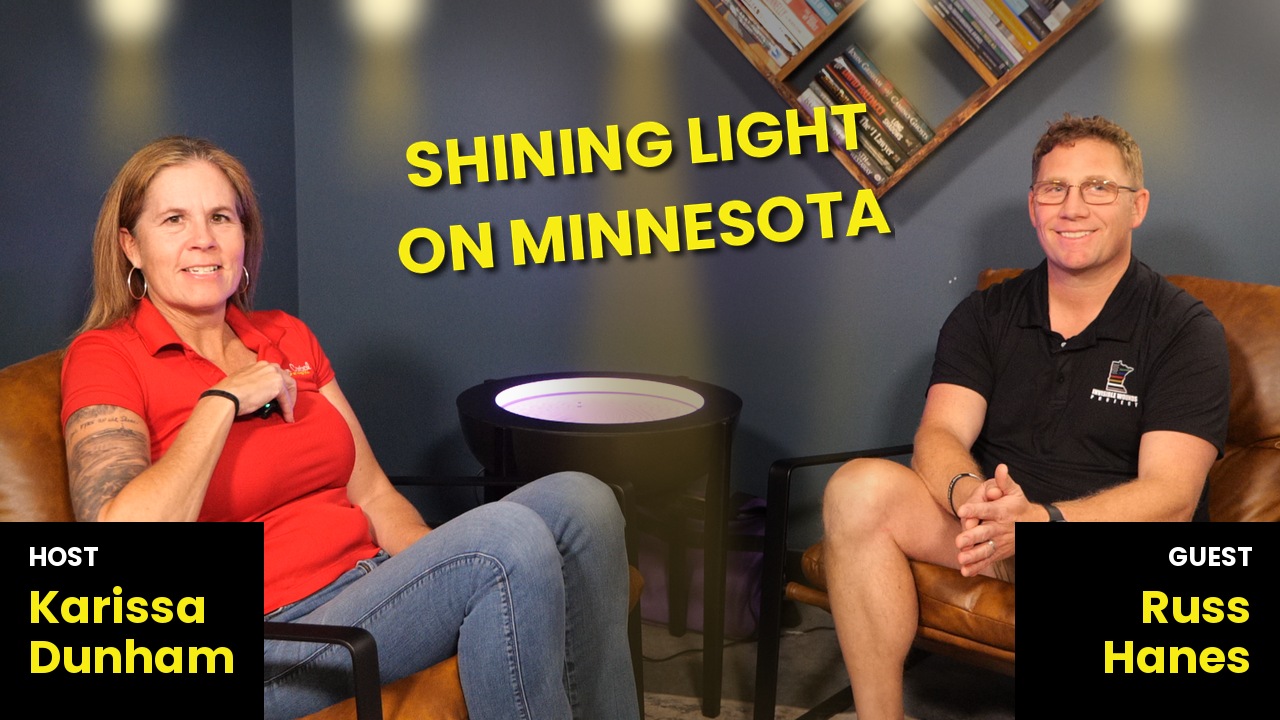
Hello everyone. I'm Karissa from Shining Light on Minnesota. We are in Forest Lake today at Invisible Wounds with Russ. Welcome Russ. Thanks for having me. You bet. So, let's tell everybody a little bit first of all what Invisible Wounds Project is and what got you into it. So, Invisible Wounds Project, we're a nonprofit here based in Forest Lake. We work with current and former military, police, fire, EMS, frontline medical staff, corrections, 911 dispatchers, and then their families related to mental health, wellness, PTSD, and suicide. Uh, I spent 17 years myself working in public safety. I was a police officer, y corrections officer, 911 dispatcher. uh in 2015 2016 uh I was really struggling with PTSD and my mental health uh suicidal ideiation and when I looked around for help at that time there really wasn't any for first responders and so um at that point uh when I got through it invisible wounds project uh was developed essentially to make sure that not only vets but also first responders and then their families had a a place to go and and find that support. Amazing. So, you guys have I mean it's a big facility here, but one of your main focuses is woodworking. Tell everybody a little bit about the wood part of it, how that got started, you know. So, the Yeah. So, the arts is a huge part of it, the woodworking, um the craft room, all of that. Yeah. We we really kind of stumbled into it.
Um, we had some first responders that were at a wood shop and we were sending some people there to, you know, to work with them. Yeah. and uh found out that just you know people were going there and and making stuff, but it was really it wasn't as much about the making the wood products as it was uh being around other people and and that just it allowed people to do something with their hands, have some conversation with other people um who who understood where they were at because they'd been there themselves and and find that common ground. And then it's it's just a easy entrance. Yes. Um you're not saying, "Hey, I need to go see a therapist." You're just I'm here to make a pen. I'm going to make sawdust. We call it sawdust therapy. Uh it's it's just a that Yeah, that's how we got started. It's art therapy. I mean, so so we ended up uh we were in that wood shop down in White Bear Lake for a year and a half and then they eventually sold and so we were looking for a space right for the wood shop um because we had such incredible uh transformations from people going into there and then um that's where then the whole Invisible Wounds Project support center came to be. Definitely. and you're working towards having a mobile unit now and a little bit about that because I know people when they are going through things they don't want to come in the door. Yeah. So I mean one of the things we can make this as accessible and as welcoming as possible but sometimes there's that that feeling of just not wanting to walk through the door, not wanting to be seen in that way.
And and physically I mean not everybody we're in Forest Lake. I mean, we do get people from across the state in western Wisconsin, but it's still it's not always easy to get here, right, for everyone. So, uh, our mobile wood shop and wellness program is, uh, it's it's a 30foot trailer that we're building right now, and that will, uh, deploy to different areas of the state in western Wisconsin. Um, and then it will be towed, uh, by, uh, our plan is to have like an RV that will tow it. And so the RV will act as a mobile wellness unit and be able to bring some of our mental health and wellness programming um groups and stuff like that on location to places and then the wood shop will be a part of that as well. So um this episode is brought to you by Sun Control of Minnesota, your window film professionals. Did you know that Sun Control of Minnesota does window film, safety security film, wall graphics, vehicle graphics, architectural films, and so much more? protecting what you love since 1978. Kind of essentially a mobile support center shop where we'll go out and meet people where they're at. So maybe we'll be in Rochester, Mankato, St. Cloud, you know, Duluth and hit hit different uh spaces. Yeah. Amazing. So you have all of that going on. What is do you think what has been some of the biggest feats and things that you can say, I've done it. I've gotten here and I've learned from it.
Um you know, every day we continue to learn. Uh there's no road map to what we've done, right? Um we've certainly looked at, you know, originally we were doing just therapy. Okay. When we first started out from 2018 to, you know, middle of 2023, we just paid for therapy services and we we'd send you to a therapist. You you needed help and and we'd get you in. Yeah. Well, what was missing was that that connection to other people and being around people is really important to our people. It's important that they have their people um who get it and understand it. And and that's what that's that's one of the biggest things that we've learned is that it's it's not people don't need the money necessarily. They need they need to know they're going somewhere where they can get support and resources that they can trust and you know and and by having that lived experience and and and I don't know that street cred that we have now of hey we've been there done that we know what works you know you just got to show up. Um that's what this place allows. Uh the support center allows that opportunity for people to just walk in and you know sometimes they're looking for, you know, coffee and a donut. Sometimes they're looking for crisis support and our job is to meet them where their needs are at. Right. Well, and it's people's families, too. I think people don't realize that it's not always just the first call, but it's everybody else that that supports, too.
So, kids, parents, wives, whatever it may I mean, there's very few who work in, you know, as as vets or, you know, in the military or or in the first responder lines that we serve, you know, all the the nurses, the the corrections officers, the 911 dispatchers, police, all that. There's very few of them that don't have some kind of family, right? And then when when you're struggling or just even if you're not struggling, you still it's almost impossible not to bring some of that stuff home. So people the families also need support and ways to cope with the things that are happening. Our job is to help improve their lives. How do we keep them healthy? How do we how do we keep them out of that crisis? How do we make it okay to not be okay and and ask for that help before it gets to be too big of a problem? Yeah. I mean, you have a lot of vets and a lot of people here that have all served as well and that have that are volunteering their time just like everybody else. So when you come in the door, you're not just meeting the people you need to meet. You're meeting people that are coming in to help and want to make a difference, too. Yeah. And a big part, I mean, our number one uh core value is service above self. Our people are servants. They they give more of themselves than they ever take back. And so our volunteers are are that way as well, right? And most of them are first responders or vets in the past, you know, vets.
and and so this place also provides them a renewed sense of purpose and mission. So if they've retired from service, you know, it's kind of the now what? And a lot of times people are just sitting around, you know, isolating, they no longer go in and, you know, they no longer go in and have that connection to the people that they they did for, you know, whether it's 10 years or 30 years. Yep. You you miss that part of it. And so this provides that opportunity, too. um for them to give back and connect to other people and yeah you know help the next one in line too. How did the story of the pen I mean there's kind of a story behind the pen and people don't know about it. How'd that come to be? So the story of the pen uh it was August of 2024. We had been open for a month here. um got a a Facebook message from one of our uh members who is an EMT and she just asked, you know, what time is the walking group on Wednesday? Um and you know, told her, "Hey, yeah, we do our walking group on Wednesdays starting at 9:00 along with coffee and donuts and we go out on a walk." Yep. So, uh she said she'd see us then. came in on Wednesday and uh she was um you know as soon as she walked through the door you could tell she wasn't doing real well but she was there uh had had coffee and a donut and then uh went out on the walk and and came back and was just like you know what in the heck is this place and I just said you know this is a community built by the community for us yep place where vets first responders their families can go be around other people who get it we don't have to, you know, prove that we deserve it or prove like anything.
It's just it's a place for you to be. Yeah. It's a safe, healthy spot for you to be. And and I could see that that just kind of resonated with her. And um I didn't want to port it on too much with, you know, her out in a public space where she had never been. Y but I made a point to talk to her later that day. Found out she was actively suicidal. Um, and we're all trained in uh suicide intervention. So went through that protocol with her through assist and uh determined, you know, a safety plan. Part of that plan was to show up again, show up on Friday. So two days later, she came in and worked in the wood shop, made a pen, uh made a couple pens with with some of our volunteers. And again, when she came in on Friday, you know, shoulders were down, head was down, just y not doing well. She just went in there. Um, these pens start out as blocks of wood in a bucket, right? And you have to drill them out. But you pick out your your uh wood and and you you put them together and then you put them on the lathe and and when you're making these pens, you know, so the lathe is spinning around, you got a you got a blade that you start trimming the y trimming it off and in the end they they turn out beautifully. Um, and in 90 minutes you can make, you know, one or two pens as a beginner. And so she was in there for 90 minutes, maybe an hour, maybe two hours. And at the end she came out and, you know, she was just smiling and like, look at I made it, right?
And so her deal, she kept coming back week after week, uh, month after month, and she'd make multiple pens every time. And then she'd she'd give uh these wristbands and these pens away to other first responders and and vets or whoever she'd meet, you know, that she thought needed a pickme up and said she'd give a pen and a wristband, say, "Hey, I I made this pen for you. If you're ever struggling, you know, you can reach out to me. Reach out to Invisible Wounds Project and uh there's a place, you know, where you can go." Yeah. Well, one of those pens ended up in the hands of uh Ellie, who is also a medic. And um Ellie and Caitlyn, they reconnected. Y uh via text. And um Caitlyn basically could tell Ellie needed to come in. And so uh it was uh May 5th of uh 25 that they met here on a Monday. And uh they they walked in, you know, Ellie walked in the door and and met Caitlyn and it was a like a one minute hug. No words said, just a hug. And uh Caitlyn just grabbed her by the hand, said, "We're we're going into the wood shop. We're going to make we're going to go make some stuff." And so they went in there for a couple hours, made pens, you know, laughed, giggled, whatever. Um the rest of the day, Ellie sat on the floor in my office and in Amber, my support center director's office, and just hung out, you know, at the end of the day. Yep. She just said, "I'll I'll see you tomorrow." And uh normally we open up at 9:00 on Tuesdays.
Yep. When I pulled into the parking lot at 7, she was already here. So, she had been here for a little bit. Yep. Waiting for us to get here. Um she came in again, not talking a lot, but on Tuesdays we have peer support. So, Yep. went to the peer support group, found out Ellie was actually suicidal. Y okay. And so again, we we just made a safety plan. Part of that plan was to uh keep coming back. And you know, um on that Friday, I had this beautiful card on my desk that, you know, just said, you know, thank you for giving me a space to be and a place to be me. Yep. Um and because of having this space, she was able to re, you know, to find other people, right, who uh were strangers but are going through the same thing. Are going through the same thing or have gone through the same thing and and those strangers, you know, turned into friends and and Ellie's still here, you know, and Caitlyn's still here and um they help other people now, too. So, it's about um just providing that, you know, our people want to feel like they belong somewhere. Yep. Um and that they're seen and and that's what Well, it's a community. This allows Yeah. Yep. What's important that you do that? I mean, who have been some of your mentors that have helped you get through to where you are today and kind of get out of your shell and do things too? I don't know if I ever need This episode is brought to you by Bravo Protection Products in Plymouth, Minnesota.
Keeping your car looking new mile after mile. Hey, did you know that Bravo Protection Products also does window film, safety security film, wall graphics, vehicle graphics, and so much more? I know I not only love them taking care of my new car, but I also get a lot of services done there as well. You should, too. I don't I don't know if I uh ever needed to come out of my shell, if you will. Um, but you know, I got into a lot of trouble in high school. Um, as as a lot of our people, they do, you know, do. Um, I uh ended up being mentored by uh a police officer who uh he was a sergeant with Mounds View Police Department, Jerry Johnson. And um I got to know him as a uh I was working at public works during summer when I got out of high school and um did some ride alongs and stuff with him. Um and I ended up you know he encouraged me to follow my passion which was originally when I was like six seven years old to become a police officer. So uh made some introductions. I ended up going to school, ended up getting a a job with St. Anthony Police Department as a reserve and CSO there when I was still really only at that point a year out of high school. So, I was able to get uh an opportunity that, you know, I felt for a lot of people. Yeah. Yeah. So, I had I had a good relationship with Jerry and then and then had a good relationship with uh Lieutenant Jeff Schaw at St. Anthony Police Department.
they both you know kind of took me under their wing and helped me along uh in the career path and um that that really made a big difference. Um I ended up meeting my wife or now wife you know pretty quickly uh right after I had started at St. Anthony as well. So um she definitely probably helped me as well get get me a little more grounded. Yep. So, um, yeah, I it's it's good to see I mean the community basis here. You have, you know, you you grew up here, you have everybody here. How do people that are not around here look to come in for help or what do they what steps have you seen them do? Yeah, so I mean people one reaching out because we can we have we have a large network of people throughout the state in western Wisconsin and we serve people throughout that whole area. So, um, really it's just having the courage to reach out and then, um, we're continuing to expand our program, obviously the the mobile wood shop, mobile wellness unit, but we're working on bringing some virtual options online. Um, we also have a lot of relationships with other organizations, too. Yep. So, you know, figuring out what people need and and what they're dealing with and and maybe where they live and and going, "Okay, how do we put a puzz How do we put this puzzle together to help Yep. help make your life reach more people?" Yeah. Because I mean, if there are people out there that are not in those organizations, they still can come in and get have sources to get help.
For sure. Yes. And you see that, too. Yep. Yep. So, you've started here in Forest Lake and you're growing beyond through the state for veterans and first responders, everybody like that. What do you think your next role is? Obviously, you've got the mobile woodworking unit, just getting more people in the door. Do you think it'll be Well, I mean, eventually we want to have more centers like this. Um, they won't necessarily all be 12,000 square feet like this. um because that takes a considerable amount of capital to do that and more staffing and um but to put in, you know, the some smaller regional centers um you know, we'll see how the mobile wood shop and wellness unit, you know, kind of how that takes off. But the idea would be that, you know, we bring that out to communities, start building up a um regular community engagement and and um you know, these these won't survive in a small right like 4,000 person like spot. We need to have enough population to serve. Um, so I I kind of look at, you know, these regional places being in more of a a hub where you have, you know, okay, maybe there's a a lot of towns around it, too. You know, let's say just St. Cloud for example. Okay. Well, there's, you know, probably a 100,000 people in St. Cloud and then the immediate surrounding area. Y um, you know, people do drive for up to an hour to get here. that's that's doesn't seem to be too much of a they drive further than that, but I mean once you get beyond an hour, it's it's a lot harder as to get people to drive.
So, I think it's a combination of these centers um and then also the mobile and uh you know, remote stuff too. Yes. I mean, there's a lot of remote stuff out there. I know that people turn to online when they need help, too. Just trying to find the right right person, the right place, but also they can't physically can't leave their house. So, the mobile unit will for that, too. Yeah. Yeah. Yeah. We're really excited about that. I think that's going to bring um just so much healing to people who who need it. Yes. Yep. How do you reach those veterans and how do you reach the first responders that are out there that don't know about you? I mean, you do a lot in the communities. Talk about a little some of the things you do in the communities. Well, we do a ton of events. Uh we do a lot of events. a lot of fundraising events, a lot of uh outreach events, um tableabling at you know differentformational tables and stuff like that. But it's really um you know a lot of people are watching us online as well. We have a very active social media. Um, but then it's it's, you know, the veteran and first responder world, while it's big, there's there's still it's still a small community. And and really, I think a lot of our connections happen because of people that we've helped, you know, letting the next person know, hey, check out the fact that you served and your dad is in the army. I mean, you have you have ties here to whomever they're looking for.
Yeah. There's going to be someone of that nature when they come in the door. Yeah. Yep. So, it's, you know, having that buy in um and that word of mouth of, hey, this is a place you can trust and you can actually trust them. Um, I think that that's that's been huge for us. Do you think that your family when they get older, like your kids and things will still carry on the generation and pass it along, or do you hope they will or I sure hope so. I mean, and if um we're absolutely building this to be a long haul. Y um this is this organization is much bigger than than me or anything like that. It certainly started small. Yep. Um but now I mean this organization belongs to our people, right? And so um I I see this as a much, you know, a long-term thing. um my my family and my kids have definitely yes been very involved in in helping us get to this point, but it's almost, you know, in the last couple years, especially since the center opened, um it it's evolved into something even, you know, more different, more incredible than I really ever imagined. Well, and it's one of those too with mental health these days. is I mean the more and more that the help is out there the more and more people come out and are willing to admit that they need help. I mean a lot of times before it was just hold it in keep it in you don't talk about it it's out of sight out of mind and it just builds up and fers in there especially in the army and things like that too.
So yeah and our goal is really to um our goal is really to give people that outlet of to talk when they when they're ready. Um, and maybe they don't even need to talk, but they just need to go in the wood shop. They just need to be around other people. They need to be around people who get it. And it's in a positive setting like we have here versus, you know, it's it's not the bar. It's not it's not doing unhealthy choices that they would normally do. It's it's about connecting people to hobbies and and music and, you know, art. And this episode is brought to you by Elite Tinting and Graphics, covering the Northshore with wraps and window film. Did you know that Elite Tinting and Graphics does window film, safety security film, wall graphics, vehicle graphics, and architectural film? I know I use their products. You should, too. Whatever. Yeah. So, let's talk a little bit about the facility here. So, you have a gym here. You have the woodworking center. Tell everybody else what else is in at here at this site. Yeah. So, I mean, when you walk in from the parking lot, we're in a strip mall, so you got set of double doors to walk in, and it it can be a little bit like, oh, what's what's behind that? Because it doesn't look like it's this big from the outside, but when you walk in, it's very warm, welcoming, um, you know, wood tones and and brick and stuff like that. It's um, but you walk in, it's a lounge.
It's a spot where you pool, darts, bubble hockey, foosball, you know, there's a kitchen attached to it, a coffee bar, just a spot to hang out. Yep. Um then we have an event center which we do training, education, and um it's available for rent for weddings and birthdays and receptions and all that kind of stuff. Yes. Um but you know, on on some days there's kids in there playing, you know, playing tag and whatever, like running around being kids. kids being kids and but then we have a big focus on the arts and and wellness. So we have our wood shop, we have our laser room, we have a finishing room, we have the painting room or the art room and um and that's all about getting creative. We have 3D printer, we have lasers, we got we can engrave anything. Um we can make anything out of wood you ever ever could imagine or want. Um and and it it's given people that outlet to be creative and and and learn new skills maybe that they never thought that they could ever do. Um and then on the art side, you know, we have different instructors that come in and teach different things. And um the gym uh we just completed this year along with the kitchen. So uh the gym we have, uh two personal trainers that are are on staff. Um we have different programming for individuals in there. Uh we do, you know, consultations and and help set people up on plans that are going to um you know, maybe they they have certain goals for their wellness that they're focused on and how do we how do we help match a program to them?
Yeah. and maybe they just need to come in there and punch the heavy meeting people where they're at. Um giving people an outlet to uh you know do what they need to do. We we have you know embedded care team staff too. So, our wellness director and we have a peer support uh specialist and um so, you know, it's helping people that when they need the help, they have it. It's not a big wait list. You you just walk in or you call or email the parking lot and we'll know you're there and just we'll come out and get you. Yeah. So, we have we have signs in the parking lot now. Just, you know, if people make it this far. Yep. Give us a call. we'll come out there and we'll we'll we'll come help you make make the last steps inside. Yep. Which is important. I'm glad you guys are doing that. You have a lot coming up in the future. What do you think has been some of the hurdles that you've kind of overcome that have gotten you to where you are today? Um you know being able to adapt and overcome, right? Okay. That's one our that's our third core value. uh you know you have to not be so stuck in saying well I know this is what we got to do and this is how we're doing it and you you have to you have to change right um sometimes what you think is a bestlaid plan uh actually that didn't work right and being willing to say you know what we failed there we're going to change it we're going to do this this is how we fix it and I learned we'll we'll just try it a different way next time y um so that that's been huge.
Uh, you know, realizing that, um, I mean, me personally, it started off as a small kind of a a one-man band. I mean, it had a board of directors, but really it was, you know, whoever was the executive director and the, you know, it kind of fell on shoulders there. And you have to be able to uh empower other people to get involved. Yes. And you know, uh, you can go fast alone, right? But you can go far together. Yep. Um, I don't know whose quote that is, but I know it's not mine. I know it's out there, but uh, you have to allow other people to use their skill sets and and understand you're not a end all beall, you know, everything. So, putting the right people into the right spots um allowing them ownership and uh the ability to to do what needs to be done correct is is incredibly important. Yes. What do you think you would tell the viewers that are out there listening or that want to just either know more about you or what would you what kind of advice would you give them? Uh go to our website. Yep. Check out our website. Go to our our social media, our Facebook page. Um so our website's iw project.org. Our Facebook is Invisible Wounds Project. Um or simply stop in. We are open Monday through Friday. Uh basically 9 to5. We're open to tours. Um we'll show people around. We're we're in Forest Lake, uh 840 Lake Street South. So it's called the Lakes Shops Center. Um there's a strip mall.
There's Mike's Discount Foods is our neighbor. They're right on the end. And then we're the second one in. Amazing. Um, so right off of Highway 61 just south of uh downtown Forest Lake. Perfect. Well, people know how to get a hold of you. They know where to find you. Is there any last piece of advice that you'd give to the listeners at all? You know, um I think the one thing that really also separates us is just be authentic. Be your true self. We all make mistakes. We all do things that oh that could have been better. Um but when you are your own authentic self, y um people expect you to make mistakes and and um human and uh I think you earn a lot more trust and and buy in from people when you when you're not fake and and you're just you just are who you are, right? So and show up. Yeah. Show up. Perfect. Well, thank you so much for being on today. We appreciate being here. Uh keep shining light, everybody. And thanks again. Thank you. Yep. Thanks.